
What Is Selective Mutism?
The word “selective” can be confusing because it may sound as though the child is choosing when to speak. In reality, children with selective mutism are not simply refusing to talk or trying to be difficult. Anxiety can temporarily interfere with their ability to use their voice, even when they know exactly what they want to say. Selective mutism is recognized as an anxiety disorder that affects communication.
Some children with selective mutism communicate through gestures, facial expressions, pointing, writing, nodding, or whispering to a trusted person. Others may appear still, expressionless, unusually cautious, or unable to respond at all when attention turns toward them. These reactions may be mistaken for stubbornness, extreme shyness, a language delay, or a lack of understanding.
Understanding what selective mutism looks like is an important first step toward helping a child feel safer and more confident. This guide explains common signs, why speaking may feel difficult, what families and teachers can do, how speech-language pathologists may help, and when it may be worth seeking a professional evaluation.
Understanding Selective Mutism in Children
A Child May Talk at Home but Not at School
One of the most recognizable patterns of selective mutism is a child who speaks freely at home but does not speak at preschool or school. At home, the child may be energetic and expressive. They may argue with siblings, ask many questions, sing along with music, and talk comfortably with familiar family members. In the classroom, that same child may be unable to answer their name during attendance or ask to use the bathroom.
The situations in which a child speaks can vary. Some children talk only with immediate family members. Some speak with classmates but not adults. Others whisper to one trusted friend or teacher but cannot speak when a group is listening. A child may also speak in an empty classroom but become silent when another student walks into the room.
Children develop communication skills at different rates, but families may find it helpful to review typical speech and language milestones from birth to age 5 when deciding whether a concern needs further attention.
These differences are not usually explained by a child forgetting how to speak. Instead, the child’s ability to use speech changes according to how safe, familiar, and closely observed they feel. This pattern is why families sometimes describe selective mutism as a “freeze” response rather than a deliberate refusal to participate.
Selective Mutism Is More Than Ordinary Shyness
With selective mutism, the difficulty speaking is generally more consistent and disruptive. The child may remain unable to talk even after attending the same classroom for weeks or months. They may want to answer a question or join a game but feel physically unable to make their voice come out. Some children later tell their parents that their throat felt tight, their words felt stuck, or they were afraid everyone would look at them.
Selective mutism can interfere with learning, friendships, self-advocacy, and everyday participation. A child may understand the lesson but be unable to demonstrate what they know verbally. They may also avoid situations in which they expect someone to ask them a question. This level of interference helps distinguish selective mutism from a child who is simply quiet or slow to warm up.
The Child Is Not Choosing to Be Silent
Pressure can increase the child’s awareness that everyone is waiting for a response. The longer the silence continues, the more uncomfortable the interaction may feel. The child may freeze, look away, hide behind a parent, or become tearful. Even a promised reward may not help because the child’s difficulty is not caused by a lack of motivation.
A more helpful approach is to remove the immediate demand to speak while continuing to include the child warmly. Adults can accept gestures, pointing, drawing, or other forms of communication and give the child time to become comfortable. Guidance for families commonly emphasizes avoiding pressure, punishment, bribery, and negative labels such as “the quiet one.”

Signs and Possible Causes of Selective Mutism
Common Signs of Selective Mutism
A child with selective mutism may communicate nonverbally by nodding, pointing, using gestures, writing, or relying on another person to speak for them. Some children appear relaxed while communicating this way. Others show visible signs of anxiety, such as tense posture, limited eye contact, a frozen facial expression, difficulty moving, or staying very close to a trusted adult.
The child may also have difficulty eating in front of others, using public bathrooms, greeting people, speaking on the telephone, reading aloud, or participating in performances. Not every child will show all these signs. The key pattern is that speaking becomes reliably difficult in particular situations and the difficulty begins to affect daily life.

Why Does Selective Mutism Happen?
Some children become particularly anxious when they believe others are listening to or evaluating their speech. A small speaking expectation, such as answering “yes” or “no,” can feel much larger to a child whose nervous system has entered a freeze response. After the child has remained silent several times, they may begin to worry about what will happen when people finally hear them speak.
Selective mutism does not mean that a family caused the problem. It also does not mean that a child has experienced trauma, although trauma and other emotional concerns should be considered when relevant. A careful evaluation looks at the whole child rather than assuming that every quiet child has the same underlying needs.
Speech, Language, Sensory, and Learning Differences
Children learning more than one language may also go through a normal quiet period while becoming comfortable with a new language. This is not automatically selective mutism. A bilingual child with selective mutism generally shows an anxiety-based pattern that cannot be explained only by limited familiarity with the language being used in that setting.
A speech-language evaluation can help determine whether the child has any additional communication needs. Because speaking directly to an unfamiliar evaluator may be difficult, the assessment may include parent interviews, teacher information, home recordings, play-based observation, nonverbal responses, and activities completed with a trusted adult. ASHA recommends assessment and treatment that include family involvement and collaboration with other professionals when appropriate. Image Placement: Place after the third H3 subsection and before Main Content Section 3. Use a horizontal image with the child and caregiver positioned slightly off-center.
How Selective Mutism Is Evaluated and Treated
What a Selective Mutism Evaluation May Include
Selective mutism is usually evaluated through collaboration among the child’s family, school, and healthcare professionals. Parents may also find it helpful to learn what happens during a speech and language evaluation. Depending on the child’s needs, the team may include a pediatrician, psychologist, psychiatrist, speech-language pathologist, teacher, school counselor, or occupational therapist. Each professional looks at a different part of the child’s development and daily participation.
The team may ask where the child speaks, who the child speaks with, how loudly they speak, and what makes communication easier or harder. They may also consider how long the pattern has been present and whether it interferes with school, friendships, healthcare, or family activities. Hearing, speech, language, learning, and developmental history may be reviewed so that other explanations are not overlooked.
A child should not have to speak during the first appointment for the evaluation to be useful. In fact, immediately demanding verbal answers may prevent professionals from seeing the child’s true communication abilities. Information from home videos and familiar communication partners can help the team understand how the child communicates when anxiety is lower.
What Selective Mutism Treatment May Look Like
As the child becomes more comfortable, treatment may gently expand the situations in which speech occurs. For example, a child might speak with a parent in an empty classroom. A familiar teacher may then enter quietly and join the activity without immediately asking questions. Over time, the child may practise speaking with additional people, in different rooms, and during everyday school routines.
Approaches may include gradual exposure, stimulus fading, shaping, positive reinforcement, and strategies for managing anxiety. Treatment should be individualized and should not feel like forcing the child to speak. Because selective mutism affects both anxiety and communication, coordinated work among behavioral health professionals, speech-language pathologists, families, and school staff is often helpful.
The Role of a Speech-Language Pathologist
A speech-language pathologist, often called an SLP or speech therapist, may assess the child’s speech, language, voice, fluency, and social communication. The SLP can also help adults understand how anxiety affects communication and identify ways to make interactions feel less demanding. This can be especially important when a child’s silence has been mistaken for not understanding directions.<br><br>
During therapy, the SLP may begin with activities that do not require speech, such as drawing, building, movement, or games with predictable routines. The child may communicate by choosing, pointing, or making sounds before gradually moving toward words and conversation. The pace should reflect the child’s comfort and readiness rather than an adult’s preferred timetable.<br><br>
An SLP may also work with teachers to change how questions are asked, create low-pressure speaking opportunities, and support classroom participation. Selective mutism is not treated simply by correcting speech sounds or repeatedly asking the child to talk. The communication plan must address the anxiety that makes speaking difficult in particular environments.
When to Seek Help for Selective Mutism
When Silence Is Affecting Everyday Life
Parents do not need to wait until a child becomes extremely distressed. Early support may prevent silence and avoidance from becoming more deeply connected with school and social situations. A professional can also help determine whether the child is experiencing selective mutism, ordinary shyness, a communication difference, difficulty with a new language, or another concern.
A good starting point may be the child’s pediatrician, school support team, a licensed mental health professional familiar with childhood anxiety, or a speech-language pathologist experienced with selective mutism. The most helpful care is often collaborative rather than placing the entire responsibility on one professional.
Signs That Additional Support May Be Helpful
- The child talks comfortably at home but consistently cannot speak at preschool, school, or community activities.
- The child appears frozen, frightened, or physically unable to respond when someone expects an answer.
- The child relies on a parent, sibling, or friend to speak for them in most public situations.
- The child cannot ask for help, report pain, request the bathroom, or communicate important needs outside the home.
- The child avoids school, parties, appointments, clubs, or family gatherings because speaking may be expected.
- The difficulty has continued beyond the child’s normal adjustment period in a new environment.
- Teachers cannot accurately assess what the child knows because the child is unable to answer verbally.
- The child is becoming upset, embarrassed, isolated, or increasingly worried about other people hearing their voice.
- There are additional concerns about speech sounds, language development, stuttering, hearing, learning, sensory needs, or emotional well-being.
Support Should Feel Gradual and Respectful
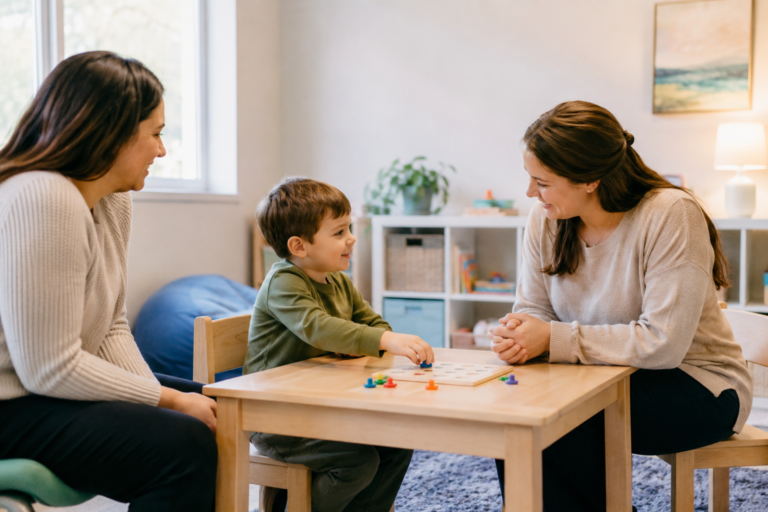
Adults should avoid surprising the child with public speaking demands or celebrating speech so dramatically that the child becomes the centre of attention. When the child does speak, a calm and natural response may feel safest. A simple continuation of the conversation often communicates, “Your voice is welcome here, and you do not need to perform for us.”
Progress may not follow a straight line. A child may speak with someone one day and struggle the next, particularly when tired, stressed, ill, or adjusting to a change. These fluctuations do not necessarily mean that support has failed. Patient teamwork can help the child develop confidence across a wider range of people, places, and activities. Image Placement: Place beneath the support section. Use a wide image showing collaboration among the parent, teacher, and professional without making the child the visual centre of attention.
Frequently Asked Questions About Selective Mutism
Is selective mutism a child refusing to talk?
No. Selective mutism is not usually a child deliberately refusing to speak. The child may desperately want to answer but experience an anxiety response that makes using their voice feel impossible in that situation. Calling the behaviour stubborn or disrespectful can increase shame and make communication harder.<br><br>
It is more helpful to think of the child as temporarily unable to speak rather than unwilling to speak. Adults can reduce direct pressure, accept other forms of communication, and provide gradual opportunities for the child to use their voice as comfort develops.
Can a child with selective mutism talk normally at home?
This difference between settings is one of the condition’s central features. The child’s speech ability remains present, but anxiety affects when and where that ability is available.
Is selective mutism a child refusing to talk?
It is more helpful to think of the child as temporarily unable to speak rather than unwilling to speak. Adults can reduce direct pressure, accept other forms of communication, and provide gradual opportunities for the child to use their voice as comfort develops.
Will a child simply outgrow selective mutism?
Seeking guidance does not mean that something is seriously wrong with the child. It provides an opportunity to understand the anxiety, reduce unhelpful pressure, and create a coordinated plan before communication difficulties interfere more significantly with daily life.
Should teachers make a child with selective mutism answer questions?
Verbal participation can be introduced gradually through an agreed support plan. The child may first communicate with a trusted person, then with one additional adult, and eventually in less predictable classroom situations as comfort grows.
Can speech therapy help selective mutism?
Because selective mutism is anxiety-related, speech therapy may be combined with support from a psychologist, psychiatrist, counsellor, pediatrician, or school mental health professional. Treatment is generally most effective when the adults in the child’s life follow a consistent and respectful plan.
Not Sure Where Your Child Falls?
Answer a few questions and we’ll tell you whether their development
looks on track — or whether it’s worth talking to an SLP.
A Few Final Thoughts About Selective Mutism
Selective mutism can be confusing because the child’s communication may look completely different from one place to another. A child who fills the house with conversation may be unable to say a single word in the classroom. That contrast is real, and it does not mean the child is being manipulative or choosing to make life difficult.
The most helpful first step is often changing the way adults understand the silence. When parents and teachers recognize that anxiety is interfering with speech, they can replace pressure with patience, predictable routines, and small opportunities for successful communication.
Children with selective mutism deserve to be included even when they are not yet speaking. Gestures, drawings, written responses, play, and facial expressions are meaningful forms of communication. These options can help the child participate while a thoughtful treatment plan gradually supports spoken communication.
The American Speech-Language-Hearing Association’s selective mutism resource also provides detailed information about assessment, treatment, and the role of the speech-language pathologist.
Parents do not have to work through these concerns alone. A speech-language pathologist, mental health professional, pediatrician, and school team can help clarify what the child needs and create a plan that feels supportive rather than frightening. Progress may take time, but calm, coordinated support can help a child feel safer using their voice in more places and with more people.