
Role Play Activities for Toddlers and Preschoolers
Role play activities for toddlers and preschoolers do not need to involve elaborate costumes, expensive playsets, or a perfectly planned activity. A toddler pretending to feed a stuffed bear or a preschooler turning the couch into a bus is already practicing the beginnings of imaginative play, communication, and storytelling.
For many families, pretend play also offers a surprisingly natural way to support speech and language milestones birth to age 5. Children can hear useful words, practice taking turns, create little stories, and communicate ideas without feeling as though someone is testing them or asking them to perform.
There is a wide range of typical play styles. One child may happily act out an entire restaurant scene, while another may prefer repeating a simple routine such as putting a doll to bed. Development also changes over time, with early pretend actions often becoming longer and more imaginative as children gain experience and communication skills. CDC developmental guidance describes pretend play emerging during the toddler years and becoming more developed during preschool play.
The role play ideas below are designed to be flexible. You can make them simpler for a young toddler, add more language and storytelling for a preschooler, or simply follow your child’s lead and enjoy the interaction. The goal is not to create a lesson. It is to create opportunities for meaningful communication through play.
Why Role Play Helps Children Learn to Communicate
Play gives words a meaningful reason to be used
This is one reason play can be so useful for communication development. Instead of asking a child to name a series of objects, an adult can simply join the activity and add helpful language. While a child feeds a doll, for example, the adult might say, “Baby’s hungry,” “More banana,” or “Oh, all done.”
ASHA includes pretend games such as playing house among its suggested activities for encouraging speech and language development. Shared play also creates opportunities for communication to move back and forth between a child and another person, through words, gestures, facial expressions, sounds, and actions.
Role play encourages back-and-forth interaction
Consider a simple pretend restaurant. One person orders food, another person prepares it, and someone may complain that the soup is too hot. Even a very simple version of this game encourages the child to notice another person, respond, and contribute something to the shared activity.
A toddler may participate mostly through actions, sounds, pointing, or a few words. A preschooler may create detailed conversations and negotiate who gets to be the cook. Both children can be learning through the activity, even though their communication looks very different.
Pretend play can grow along with your child
This development does not need to be rushed. A child who repeatedly feeds a doll is still exploring an important idea: one object or action can represent a familiar experience. Adults can gently expand that play by adding one related idea, such as wiping the doll’s mouth after the meal.
As children become more comfortable, their play may include characters, problems, feelings, plans, and imaginative events. A preschooler might announce that the stuffed dog is sick, drive it to the animal hospital, and explain what the veterinarian needs to do next.
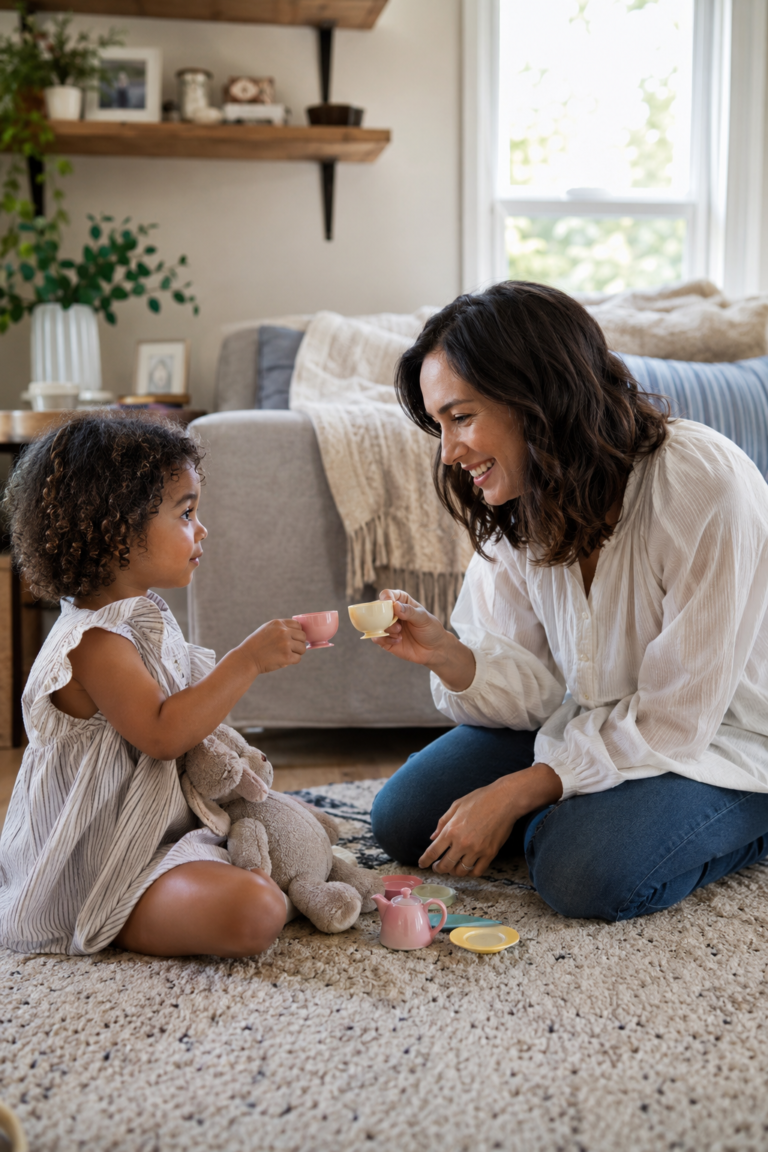
Simple Role Play Activities for Toddlers
Feed and care for a doll or stuffed animal
Keep your language simple and connected to the action. You might say, “Bear is hungry,” “Drink milk,” “Night-night,” or “Bear needs help.” There is no need to ask your toddler to repeat these words. Hearing useful language during an enjoyable routine can be valuable on its own.
Follow what your child seems interested in doing. When the play starts to slow down, you can add one small idea. Perhaps the bear sneezes and needs a tissue, or the doll wakes up and asks for breakfast. Small additions are usually easier for toddlers to follow than a complicated story.
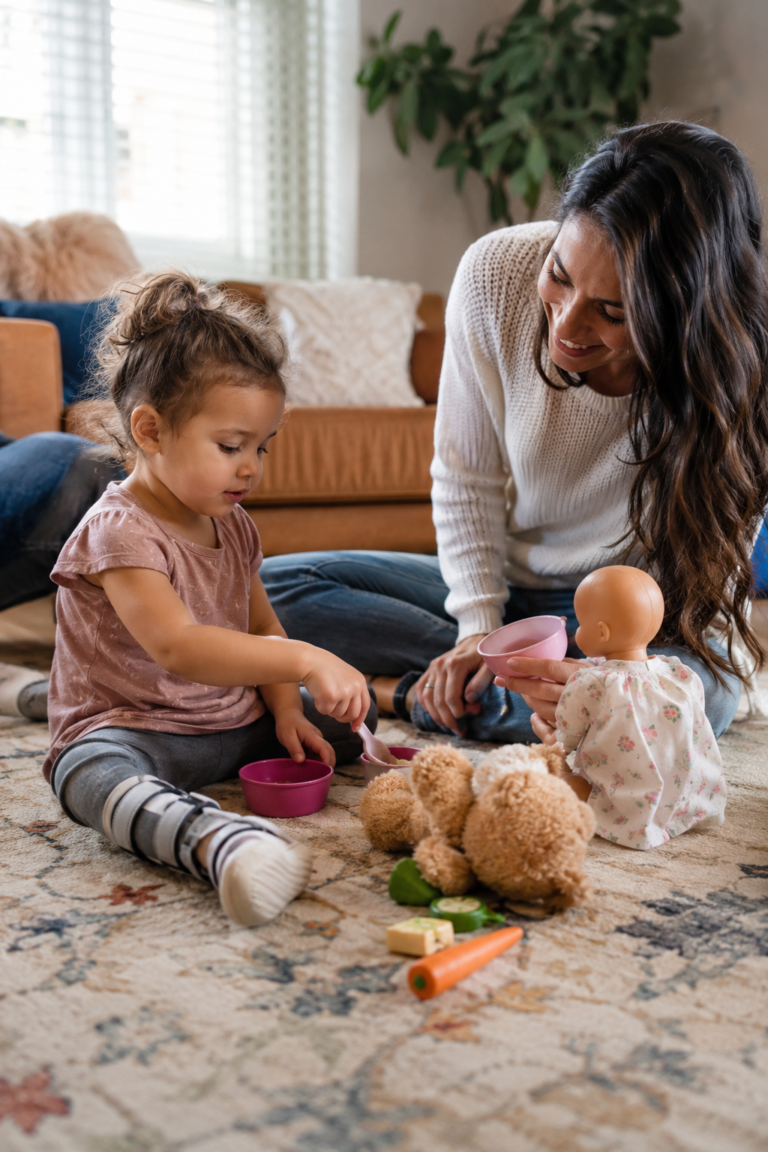
Play kitchen or pretend restaurant
A pretend kitchen can be as simple as a bowl, spoon, cup, and a few safe household items. Your toddler can stir imaginary soup, pour a drink, make pretend coffee, or serve snacks to family members and stuffed animals.
This activity naturally introduces action words and useful combinations. An adult might model, “Cut apple,” “Stir soup,” “More juice,” “Mommy’s turn,” or “It’s hot.” Keep the words slightly above your child’s current level without turning every moment into a question.
For a toddler who is not yet using many spoken words, gestures and sounds can be part of the game too. A child may blow on the hot soup, make a pouring sound, point to a cup, or hand you a plate. These are meaningful ways of participating in a shared interaction.
Use toy animals for simple action stories
Begin with something your child already enjoys. Perhaps the cow walks into the barn, the dog falls asleep, or the duck jumps into pretend water. Repeat helpful words and short phrases as the action happens, such as, “Doggy run,” “Duck splash,” or “Cow go in.”
When your toddler becomes comfortable with the routine, change one small part. The animal might get stuck, feel hungry, or need help finding its home. These little play problems can invite a child to communicate through a word, gesture, sound, facial expression, or action.
Fun Role Play Activities for Preschoolers
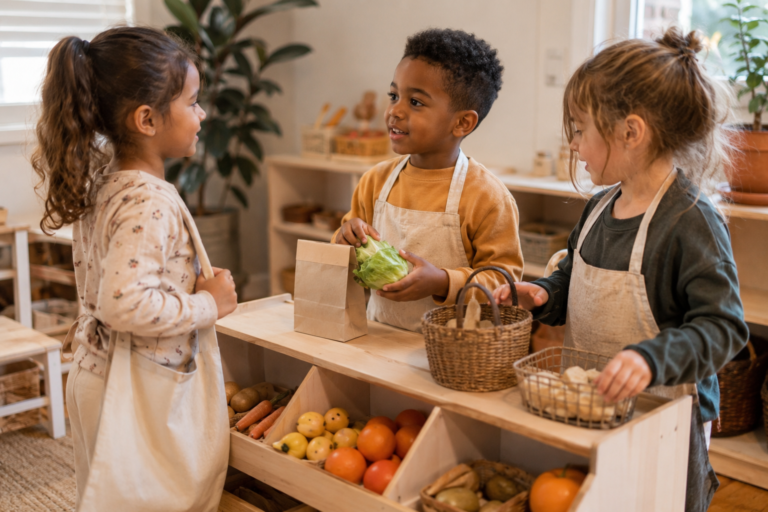
Create a pretend grocery store
A preschool grocery store can be made with empty food containers, play food, a basket, and a few pieces of paper. One person can be the shopper while another is the cashier, and the roles can change whenever the children are ready.
This type of dramatic play for preschoolers encourages functional language. Children can practice greetings, requests, questions, descriptions, and simple problem solving. You may hear conversations such as, “Where are the apples?” “I need some milk,” or “Sorry, we’re all out.”
Adults can join without controlling the game. Try taking a role and creating a small reason to communicate. Perhaps you cannot find the bananas or you forgot your shopping bag. Let the child decide how the story develops rather than correcting the way the game is played.
Set up a doctor or veterinarian office
This kind of role play creates opportunities for children to talk about body parts, actions, feelings, and sequences. A child might explain that the bear hurt its paw, needs medicine, and must rest at home. You can support the story with comments such as, “He looks worried,” or “What should we do next?”
Role play can also help children explore familiar or unfamiliar experiences. Pretending about a doctor’s visit does not guarantee that a child will feel comfortable during a real appointment, but it can give the child a playful setting for exploring some of the words, routines, and feelings connected with the experience.
Turn everyday spaces into imaginative places
Open-ended settings often invite more child-created language because there is no single correct way to use them. A cardboard box can change from a boat to a bakery counter within minutes. The child has opportunities to explain ideas, assign roles, and tell other people what is happening.
Try letting your child become the director. Listen to the plan, take the role you are given, and add comments that keep the interaction moving. Preschool role play often becomes richer when adults are willing to be playful participants rather than instructors.
How Parents Can Support Language During Role Play
Follow your child's idea before adding your own
A child who repeatedly drives a toy car to the same place may have a clear play idea, even when the adult does not understand it yet. You might imitate the action, make a simple car sound, or say, “Car goes home.” This shows the child that you are paying attention.
Once you are part of the play, add language or one small new idea. This approach can make role play feel shared rather than adult-directed. It also gives children room to communicate about something that genuinely interests them.
Signs that may be worth discussing with a professional
- Your child is not developing new communication skills over time.
- Your child has lost words, gestures, social communication skills, or play skills they previously used.
- Your child rarely attempts to communicate wants, needs, or interests using speech, gestures, pictures, signs, AAC, or another communication method.
- Your child has difficulty understanding everyday language or following familiar routines beyond what you would expect for their developmental level.
- Communication difficulties frequently lead to frustration or make everyday participation harder.
- You have ongoing concerns about your child’s speech, language, interaction, or play development.
A speech-language evaluation can look beyond word counts
A speech-language pathologist can learn a great deal by observing how a child communicates during natural interaction and play. Depending on the child and the concern, an evaluation may consider language understanding, spoken language, gestures, social communication, speech sound development, play skills, and other communication methods.
Evaluation does not mean assuming that something is wrong. It is a way to better understand a child’s strengths, current needs, and whether support or monitoring may be appropriate. For children under age three in the United States, families can also ask about their state’s early intervention program.
Parents know their children in ways that a professional seeing them briefly cannot. Sharing what you notice at home, during play, with family members, and in other everyday situations can help create a more complete and useful picture.
Frequently Asked Questions About Role Play Activities
What is role play for toddlers?
Toddler role play does not need to look like a long story. Early pretend play may involve one repeated action before gradually becoming more connected and imaginative. The best place to begin is often with the familiar routines your child already enjoys.
At what age do children start pretend play?
By the preschool years, role play can become more developed. For example, CDC includes pretending to be something else during play, such as a teacher, superhero, or dog, among its four-year social and emotional milestones. These milestones are guides rather than rigid deadlines for every child.
Can pretend play help with speech and language development?
Pretend play should not be presented as a guaranteed treatment for a speech or language difficulty. However, shared play is a valuable context for communication, and speech-language pathologists often use playful activities as part of developmentally appropriate assessment and intervention.
What are the best role play activities for a late talker?
Try to avoid turning the activity into constant practice or requiring repeated imitation of words. Follow the child’s interest, model simple language, respond warmly to all meaningful communication attempts, and seek individualized guidance when you have concerns about development.
What should I do if my child does not like pretend play?
You can gently add a small pretend idea to an activity the child already likes, but there is no need to push. When limited play skills appear alongside broader concerns about language, understanding, social communication, development, or loss of previously acquired skills, discuss those concerns with a qualified professional.
Should I worry if my baby is quiet compared to other babies?
Open-ended materials are useful because children can decide what the objects represent. A box can be a bus one day and a veterinarian’s table the next. The interaction with another person often matters more than having an expensive or elaborate playset.
Do children need special toys for role play?
Answer a few questions and we’ll tell you whether their development
looks on track — or whether it’s worth talking to an SLP.
A Few Final Thoughts on Role Play and Communication
Role play activities for toddlers and preschoolers can be wonderfully simple. A stuffed bear that needs dinner, a cardboard box that becomes a bus, or a pretend grocery trip can create meaningful opportunities for a child to communicate and connect.
The most important ingredient is not the toy. It is the shared interaction. Watching what your child chooses, joining the idea, adding helpful language, and leaving room for the child to respond can turn an ordinary moment of play into a rich communication experience.
Try not to worry about making pretend play look perfect. Some children create long stories, while others enjoy simple actions and familiar routines. Development unfolds differently from one child to another, and milestones are most useful when viewed as part of a child’s broader developmental picture.
For more ideas about how play supports learning and communication, visit the National Association for the Education of Young Children (NAEYC).
When questions about speech, language, social communication, or play continue to worry you, reaching out for professional guidance is reasonable. Families do not have to diagnose the problem themselves before asking for help, and thoughtful early support can begin with something as simple as a conversation about what you are noticing.
Image Placement: Closing image directly before or after the final section