
Speech and Language Milestones: Birth to Age 5
Speech and language milestones can help parents understand how communication grows from tiny newborn sounds into words, sentences, stories, and real conversations. In the first five years, children learn to listen, connect, gesture, play, understand words, use sounds, and share ideas with the people around them.
Many parents look up speech and language milestones because they want reassurance. You may wonder whether your baby should be babbling more, whether your toddler should be using more words, or whether your preschooler’s speech should be easier to understand. Those are very normal questions, especially when every child around you seems to be developing at a slightly different pace.
Milestones are not meant to make parents feel worried or judged. They are best used as a gentle guide for noticing patterns over time. A child may be a little ahead in one area and slower in another, and that does not automatically mean something is wrong. What matters most is the overall picture of how your child communicates, understands, connects, and keeps building new skills.
This guide walks through speech and language milestones from birth to age 5 in a parent-friendly way. You will learn what communication may look like in babies, toddlers, and preschoolers, what skills support later talking and learning, and when it may be helpful to ask for support from a pediatrician or speech-language pathologist.
Speech and Language Milestones in Babies
Birth to 3 Months: Early Listening and Connection
Around this stage, many babies begin to quiet, smile, or turn toward a familiar voice. They may startle at loud sounds, calm when held and spoken to, and show early interest in faces. These small moments may seem simple, but they are the foundation for later back-and-forth communication.
Parents can support early speech and language development by talking during everyday care routines. Diaper changes, feeding, rocking, and bath time all give babies a chance to hear warm, meaningful language. At this age, your baby does not need lessons; your voice, facial expressions, and loving responses are already powerful.
4 to 6 Months: Cooing, Vocal Play, and Shared Attention
This is also a time when babies may begin to look back and forth between a person and an interesting object. They may smile during games, respond to tone of voice, and show excitement when a familiar person enters the room. These early social communication skills matter because language grows through connection, not just sound production.
Simple routines are helpful at this stage. You can pause during peekaboo, copy your baby’s sounds, smile when they vocalize, and give them a turn to “answer.” These little pauses teach your baby that communication goes back and forth, even before real words appear.
7 to 12 Months: Babbling, Gestures, and First Words
From 7 to 12 months, babies often begin using more speech-like babbling. You may hear repeated sounds such as “bababa,” “mamama,” or “dadada.” At first, these sounds may not have clear meaning, but over time they become more intentional and connected to people, objects, or routines.
Gestures also become very important during this stage. Many babies reach, wave, lift their arms to be picked up, show objects, point, or look where an adult points. These gestures are not “less than” words. They are meaningful communication and often help children move toward spoken language.
Some babies say a first word around the end of the first year, while others need more time. Learn more about Babies’ First Words and what they typically sound like during the first year.A first word usually has meaning and is used consistently, even if it is not pronounced perfectly. “Ba” for bottle or “da” for dog can count when your child clearly means the same thing each time.
For a closer look at this stage, see our guide to 6 to 12-month communication milestones.

Speech and Language Milestones in Toddlers
12 to 18 Months: First Words and Everyday Understanding
Understanding often grows faster than talking at this age. A toddler may follow familiar directions, look for a named object, respond to their name, or understand simple phrases used in daily routines. Parents often notice that their child knows more than they can say.
This stage is a wonderful time to model simple language without pressure. Instead of asking your toddler to repeat words again and again, you can say the word naturally in context. For example, when your child reaches for milk, you might say, “Milk. You want milk,” and then give them the milk.
Wondering when children typically begin talking and how first words develop into short phrases? Read When Should a Child Start Talking?
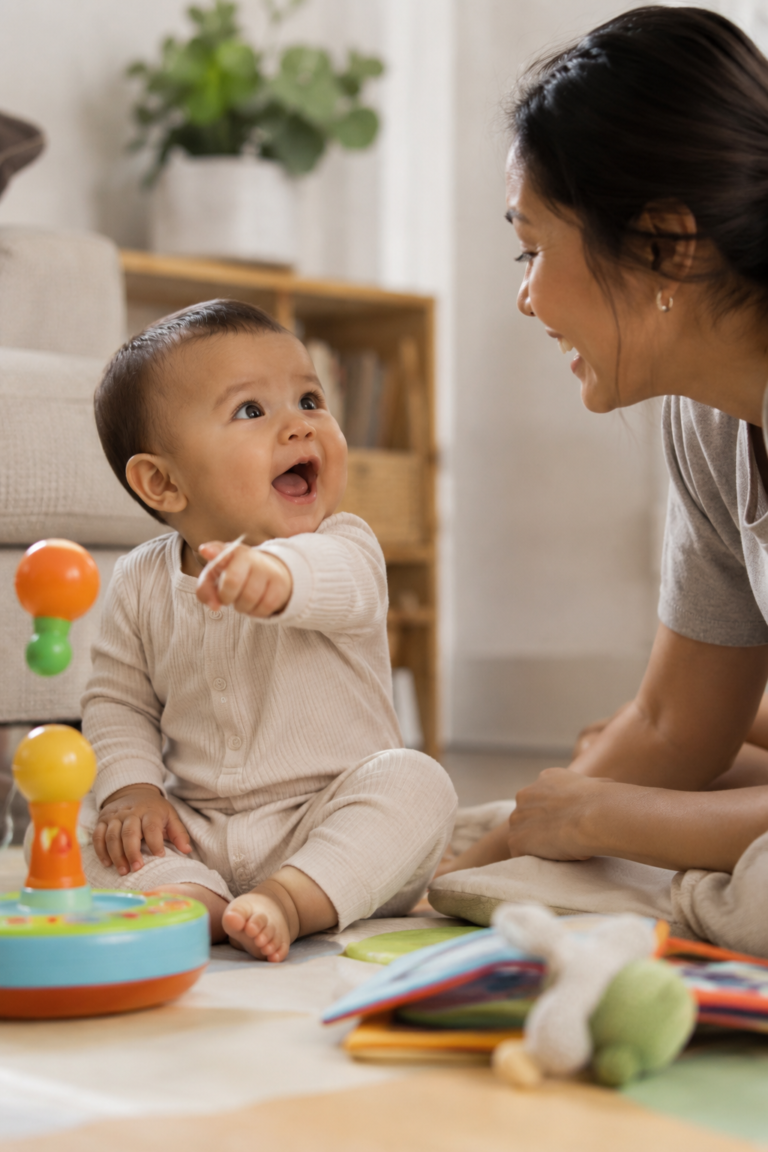
18 to 24 Months: Word Growth and Early Word Combinations
Between 18 and 24 months, many toddlers begin adding new words more steadily. They may use words for actions, people, favorite objects, animals, foods, and social routines such as “hi,” “bye,” or “more.” Some toddlers are very verbal, while others communicate with a mix of words, gestures, sounds, and facial expressions.
By around age 2, many children begin combining two words, such as “more juice,” “mommy go,” or “big truck.” These early combinations show that a child is starting to put ideas together. Grammar is not expected to be perfect, and speech may still be hard for unfamiliar listeners to understand.
Parents can help by expanding what the child says. If your toddler says “car,” you might say, “Big car,” or “Car go.” This gives your child a slightly richer model while keeping the language simple enough to copy or understand.
For a closer look at typical vocabulary growth, read How Many Words Should My Child Have at Each Age?
2 to 3 Years: Sentences, Questions, and Clearer Communication
Children this age may follow two-step directions, understand simple location words, and enjoy songs, books, pretend play, and repeated phrases. They may still make many speech sound errors, but familiar adults usually understand much of what they say by age 3.
This is also a stage when frustration can show up if a child knows what they want to say but cannot say it clearly. Calm modeling, choices, visual support, gestures, and patient listening can reduce pressure and help your child feel successful while speech and language continue to grow.
Speech and Language Milestones in Preschoolers
3 to 4 Years: Longer Sentences and Pretend Play
Pretend play becomes an important language builder during this stage. A child may make animals talk, act out family routines, create simple stories, or assign roles during play. This kind of play supports vocabulary, sentence structure, problem-solving, and social communication.
Parents can support preschool language by joining play without taking over. You can describe what your child is doing, add a new idea, or model a slightly longer sentence. The goal is not to quiz your child, but to keep the interaction enjoyable and meaningful.
4 to 5 Years: Storytelling, Conversation, and Early Learning Language
Children this age may also enjoy rhyming, silly words, songs, early sound awareness, and books with repeated patterns. These early literacy skills are connected to later reading and writing. Speech and language development at this age is not only about talking clearly; it also supports learning, friendship, and classroom participation.
Some speech sound errors may still be developmentally common, depending on the sound and the child’s age. However, by age 5, most children are understandable most of the time. A speech-language pathologist can help determine whether remaining sound errors are age-appropriate or would benefit from support.
How Understanding, Talking, and Social Communication Work Together
For example, a toddler with fewer spoken words but strong gestures, good understanding, playful interaction, and steady progress may look different from a child who is not using many words and also has limited response to name, limited gestures, or difficulty following simple directions. Both children deserve careful attention, but their needs may not be the same.
This is why parent concern matters. Parents often notice subtle changes in communication before anyone else does. If something feels off, it is reasonable to ask questions, even if other people say to wait and see.
When to Seek Help for Speech and Language Milestones
Trusting Concerns Without Jumping to Fear
Speech and language delays can happen for many reasons. Some children need a little extra support with expressive language, some need help with speech sounds, some have hearing differences, and some have broader developmental needs. An evaluation helps clarify what is going on instead of leaving parents to guess.
Early support works best when it feels practical and family-centered. A good speech-language pathologist will look at your child’s strengths, routines, play, understanding, speech sounds, gestures, and communication needs. The goal is to support your child, not label them unnecessarily.
Signs It May Be Time to Ask for Support
- Your baby does not respond to sound or does not seem to notice familiar voices.
- Your baby is not smiling, vocalizing, or engaging with caregivers as expected.
- Your child is not using gestures such as pointing, waving, reaching, or showing by around 12 months.
- Your child is not using meaningful words by around 15 to 18 months.
- Your child is not combining words by around age 2.
- Your child seems to understand much less than expected for their age.
- Your child loses words, gestures, social skills, or communication abilities they once had.
- Your child is very hard to understand compared with other children their age.
- Your child becomes very frustrated because they cannot communicate basic wants or ideas.
- You feel worried about your child’s speech, language, hearing, play, or social communication.
What Support Can Look Like
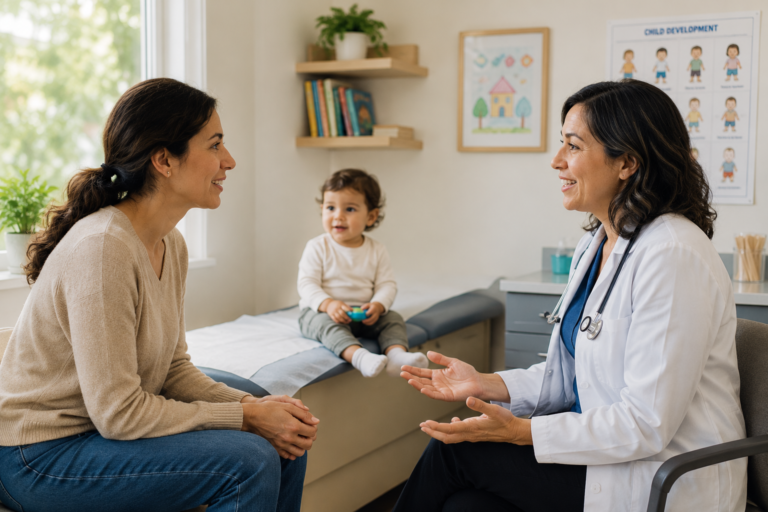
A hearing evaluation is often recommended when speech or language is delayed because children need consistent access to sound for communication development. Even mild or temporary hearing issues can affect how clearly a child hears speech. This does not mean hearing is always the cause, but it is an important piece to check.
The most helpful approach is usually calm and proactive. You do not need to panic, but you also do not need to wait months if your instincts are telling you something needs attention. Getting support early can give your child more ways to communicate and give you more confidence in how to help at home.
Want to learn more? The American Speech-Language-Hearing Association (ASHA) provides comprehensive communication milestones from birth through age 5, including listening, gestures, first words, vocabulary, and early sentences.
FAQ About Speech and Language Milestones
What are speech and language milestones?
They are helpful guideposts, not strict rules. A child’s development should be viewed as a pattern over time, including how they connect, understand, play, and communicate in daily life.
What is the difference between speech and language?
Language is how a child understands and uses words to share meaning. It includes vocabulary, sentences, directions, questions, storytelling, and social use of communication.
When should babies start talking?
A word does not have to sound perfect to count. If your baby consistently uses the same sound to mean the same person, object, or routine, that may be an early word.
How many words should a 2-year-old say?
It is also important to look at understanding, gestures, play, and frustration level. A child who is not combining words or is using very few meaningful words at age 2 should be discussed with a pediatrician or speech-language pathologist.
Should I wait and see if my child catches up?
Asking for help does not commit your child to therapy forever. It simply gives you information, practical strategies, and a plan for what to watch next.
Can screen time affect speech and language development?
Not all screen use is the same. Watching together, talking about what you see, and keeping screens from replacing sleep, play, and interaction can make a difference.
Not Sure Where Your Child Falls?
Answer a few questions and we’ll tell you whether their development
looks on track — or whether it’s worth talking to an SLP.
Few Final Thoughts on Speech and Language Milestones
At the same time, milestones should never be used to compare children harshly. Development is not a race, and children do not all grow in a perfectly straight line. What matters most is steady progress, meaningful connection, and your child’s ability to communicate in daily life.
Parents are often the first people to notice when communication feels harder than expected. That instinct is worth listening to. If you are concerned, asking for help is a caring and practical step, not a sign that you have failed or that something is definitely wrong.
With warm interaction, responsive routines, good information, and support when needed, children can build stronger communication skills over time. Speech and language grow best when children feel connected, understood, and encouraged in the everyday moments that matter most.