
Speech and Language Development: Ages 2 to 3
The period between a child’s second and third birthdays can bring remarkable changes in communication. A toddler who begins this year using a few familiar words may gradually start combining words, asking questions, describing what happened, and having short conversations. These changes are exciting, but they do not happen at exactly the same age or in exactly the same way for every child.
Parents often wonder how much a 2-year-old should talk, whether other people should understand their child, and which speech differences are still typical. These are reasonable questions. Development from ages 2 to 3 is usually a gradual process, and skills may appear in bursts rather than along a smooth, predictable timeline.
Speech and language are also more than the number of words a toddler can say. Communication includes understanding words, following directions, using gestures, sharing attention, taking conversational turns, playing imaginatively, and finding ways to express needs and ideas. A child’s overall communication pattern often provides more useful information than a single vocabulary count.
This guide explains common speech and language development from ages 2 to 3, including vocabulary growth, sentence development, understanding, speech clarity, conversation, and ways families can encourage communication naturally. It also explains when it may be helpful to speak with a pediatrician, early intervention provider, or speech-language pathologist.
What Speech and Language Development From Ages 2 to 3 May Look Like
A Growing Vocabulary
The exact number of words a child uses can be difficult to count. Families may overlook approximations, animal sounds, social words, signs, or words used only in certain situations. A consistent sound or word approximation can still carry meaning when a child uses it independently and predictably. For example, “ba” may function as a word for “ball” when the child uses it each time a ball appears.
By around 30 months, the CDC includes saying approximately 50 words among its communication milestones. That number is a general developmental marker rather than a requirement every child must meet on the same day. Vocabulary should be considered alongside the child’s understanding, gestures, social connection, play, progress, and ability to combine words.
Want to know what’s typical at different ages? Read How Many Words Should My Child Have at Each Age?
Moving From Single Words to Short Sentences
As language develops, combinations often become longer and more detailed. “Doggie run” may grow into “Doggie running outside,” while “Daddy car” may become “Daddy is in the car.” Toddlers gradually begin using action words, descriptive words, location words, pronouns, and early grammatical endings, although mistakes remain common.
By age 3, many children are using short sentences during everyday interactions. Sentence length can vary depending on the situation. A toddler may speak in longer phrases while playing at home but use fewer words when tired, overwhelmed, meeting someone new, or trying to pronounce an especially difficult word.
Understanding More Than They Can Say
Toddlers during this stage may begin following longer directions, especially when the activity is familiar. A child might understand “Get your shoes and bring them to me” or “Put the spoon on the table.” Performance still depends on attention, interest, memory, and willingness. A toddler who ignores a direction while deeply involved in play may understand it perfectly well.
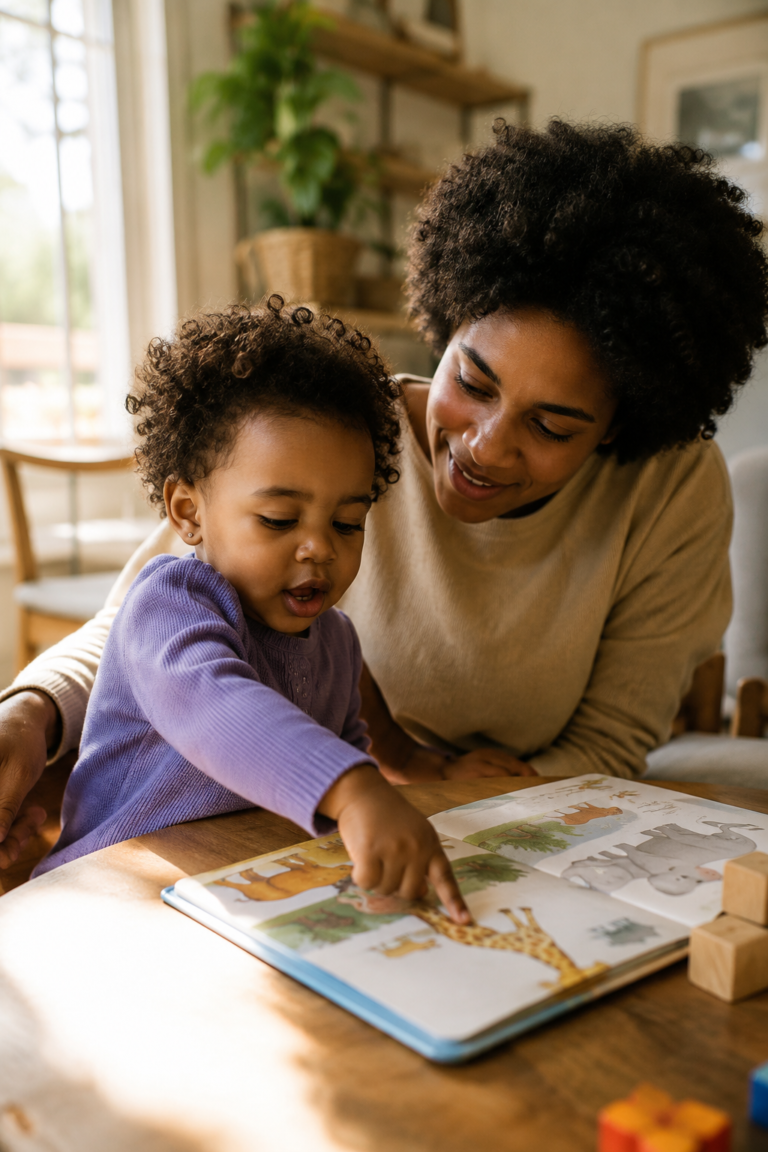
Understanding also includes grasping early concepts such as in, on, under, big, little, one, and more. Children usually learn these concepts through repeated everyday experiences rather than formal lessons. Hearing the same words during dressing, meals, cleanup, outdoor play, and book sharing helps connect language with meaning.
How Communication Changes Between the Second and Third Birthday
Conversations Become More Interactive
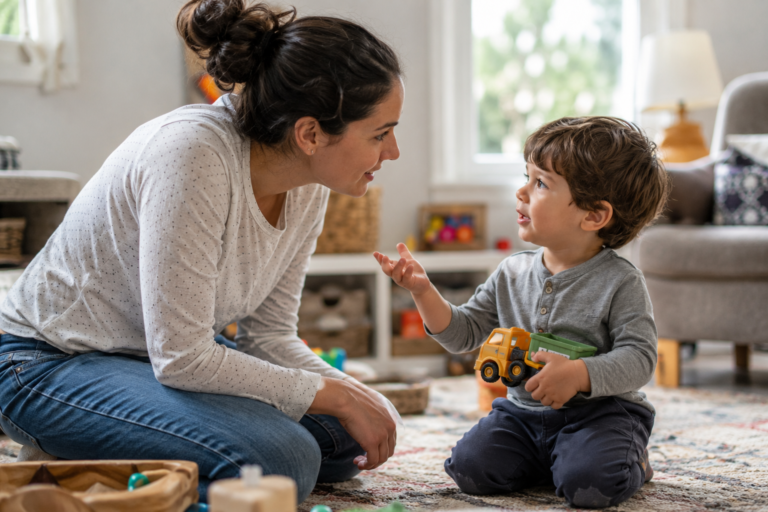
Toddlers are still learning how conversations work. They may interrupt, repeat themselves, change topics suddenly, or assume that an adult knows what they are talking about. These behaviors are common because conversational skills require language, attention, memory, social awareness, and the ability to consider another person’s perspective.
By age 3, the CDC includes participating in a conversation with at least two back-and-forth exchanges as a communication milestone. Children may show this skill while discussing a snack, telling a parent about the playground, pretending with toys, or protesting bedtime—not only during direct questioning.
Questions and Comments Become More Frequent
Comments also become more descriptive. Instead of simply saying “car,” a child may say “red car,” “car go fast,” or “Grandma has car.” These small additions show growth in vocabulary, sentence structure, memory, and the ability to share information rather than only request something.
Some children ask many questions, while others communicate more often through comments, gestures, pretend play, or quiet observation. A child does not need to display one particular personality style to be developing well. The broader question is whether communication is becoming more purposeful, flexible, and connected over time.
Pretend Play Supports Language Growth
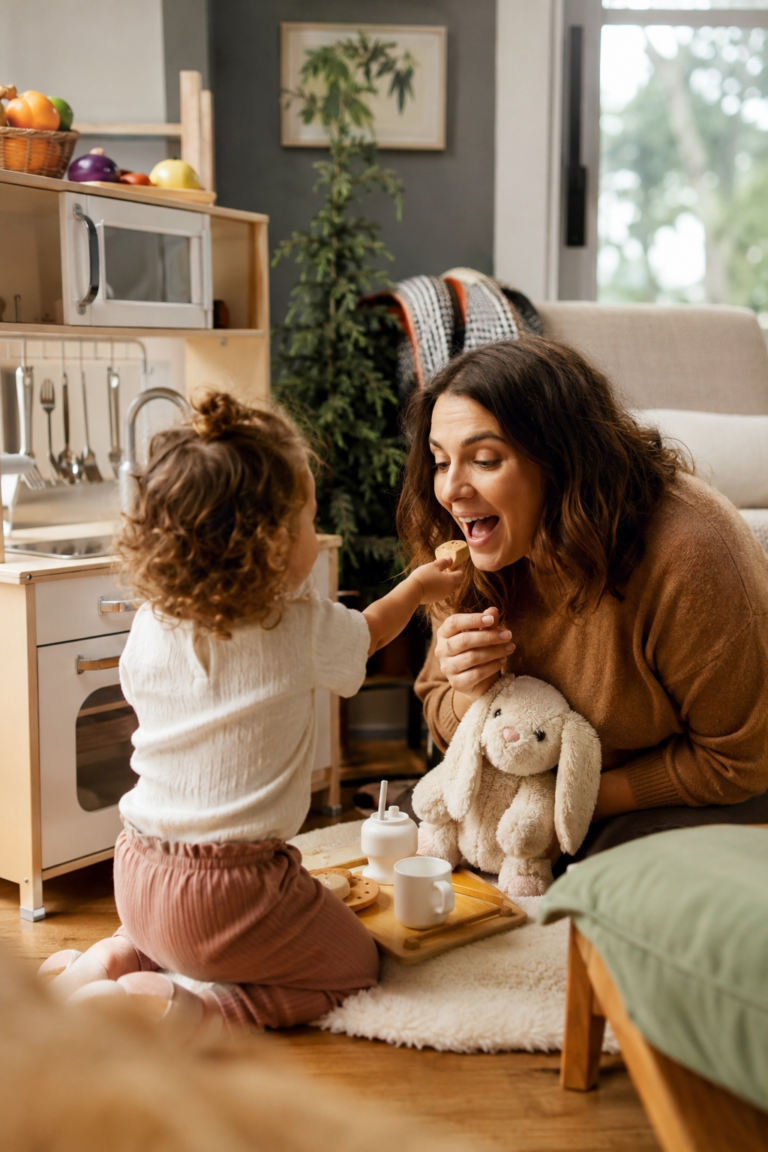
As pretend play develops, children may begin assigning roles and creating short scenarios. A stuffed animal might be sick, need food, and then go to bed. Even when the child does not narrate every action, this type of play reflects growing symbolic thinking—the understanding that one object, action, or word can represent something else.
Parents can support this development by joining the child’s idea rather than controlling the play. Brief comments such as “Baby is hungry,” “The truck is stuck,” or “Bear needs a blanket” add useful language while keeping the activity enjoyable. The goal is connection and shared imagination, not testing the child.
Speech Clarity and Sound Development From Ages 2 to 3
Why Toddler Speech May Still Be Difficult to Understand
Toddlers commonly simplify words. They may leave off final sounds, shorten longer words, replace difficult sounds with easier ones, or pronounce the same word differently on different occasions. “Banana” might become “nana,” “spoon” might sound like “poon,” and “truck” might be pronounced “tuck.” Some simplification is expected during this age range.
Speech clarity should generally improve over time, but familiar adults often understand more than unfamiliar listeners. Parents know the child’s routines, favorite topics, gestures, and usual pronunciations. A person who does not know the child lacks those clues, so occasional communication breakdowns with unfamiliar listeners are not automatically a sign of a disorder.
Clear Speech Develops Gradually
By age 3, the CDC describes talking well enough for other people to understand most of the time as a developmental milestone. This does not mean every sound or word must be perfectly pronounced. A 3-year-old may still make several age-expected speech errors while being understandable during much of an everyday conversation.
Language background matters when considering speech clarity. A multilingual child may use sounds or pronunciation patterns from more than one language. Differences caused by learning multiple languages are not speech disorders. An evaluation should consider every language the child hears and uses rather than judging the child only by monolingual expectations.
Communication Matters More Than Perfect Pronunciation
A helpful approach is to repeat the child’s message using a clear adult model. When a toddler says “tat go,” a parent might respond, “Yes, the cat is going!” The child hears the correct form without being interrupted, criticized, or required to imitate it.
There are times when speech clarity does deserve closer attention. A speech-language pathologist can examine whether the child’s errors fit common developmental patterns, whether the child has an unusually limited range of sounds, and whether difficulty being understood is causing frequent frustration or limiting participation.
When to Seek Support for a 2- to 3-Year-Old’s Communication
Looking at the Whole Communication Picture
Some children develop more slowly in one area and then make steady progress. Other children benefit from support even when family members are told to wait. Parents do not need to prove that something is seriously wrong before asking a question or requesting a developmental screening.
It is especially important to seek guidance when a child loses words, social communication, play skills, or abilities they previously used. Loss of established skills is different from developing at an individual pace and should be discussed promptly with the child’s healthcare provider.
Signs That May Be Worth Discussing With a Professional
- Your child is not using meaningful words or is using very few words by age 2.
- Your child is not beginning to combine two words, such as “more juice” or “Mommy go.”
- Your child rarely uses gestures, eye gaze, sounds, or words to communicate needs and interests.
- Your child frequently appears not to understand familiar words or simple directions.
- Your child does not seem to notice or respond consistently to voices, sounds, or their name.
- Your child’s speech is extremely difficult for familiar adults to understand.
- Your child becomes frustrated often because other people cannot understand the intended message.
- Your child uses a very limited variety of speech sounds or relies mostly on vowels.
- Your child’s communication skills are not gradually expanding over several months.
- Your child has lost words or other communication skills that were previously used.
What an Evaluation Can Tell Families
A hearing evaluation may also be recommended. A child can respond to many everyday sounds and still have difficulty hearing certain speech sounds clearly, especially when there is a history of frequent ear infections or fluctuating middle-ear fluid. Hearing information helps professionals understand the complete picture.
An evaluation may show that development is within a broad expected range, that monitoring would be appropriate, or that additional support could help. Seeking an evaluation does not commit a family to a particular treatment plan. It provides information that can help parents make informed decisions.
Want to learn more? The American Speech-Language-Hearing Association (ASHA) provides communication milestones for children 2 to 3 years old, including vocabulary growth, short sentences, pretend play, and following directions.
Frequently Asked Questions About Speech and Language Development From Ages 2 to 3
How much should a 2-year-old talk?
Word counts should not be considered alone. A child’s understanding, gestures, social interaction, play, progress, and ability to communicate needs also matter. A speech-language pathologist can help when vocabulary is very limited or communication is not expanding.
Should a 2-year-old be speaking in sentences?
These combinations often become longer between ages 2 and 3. Grammar may still sound incomplete, and pronunciation may be unclear. The important change is that the child is increasingly putting words together for different purposes.
How clearly should a 2-year-old speak?
Familiar caregivers may understand much more than unfamiliar people. Consider discussing speech clarity with a professional when even close family members understand very little, the child uses few different sounds, or communication breakdowns cause frequent frustration.
What should a child be able to say by age 3?
These skills do not appear identically in every child. A child may be strong in vocabulary but quieter socially, or highly conversational while still making many speech-sound errors. Development should be viewed as a broad pattern rather than a single test.
Does using two languages cause a speech delay?
Parents should generally use the languages in which they feel most comfortable and connected. When an evaluation is needed, the professional should consider skills across all of the child’s languages so that a language difference is not mistaken for a disorder.
How can I encourage my toddler to talk without pressuring them?
Try to balance questions with comments and avoid making every interaction a test. Songs, books, pretend play, meals, bath time, and outdoor activities all provide meaningful opportunities for language when the interaction remains warm and enjoyable.
Not Sure Where Your Child Falls?
Answer a few questions and we’ll tell you whether their development
looks on track — or whether it’s worth talking to an SLP.
Few Final Thoughts on Speech and Language Development From Ages 2 to 3
Development is not perfectly even. A toddler may talk constantly one week and seem quieter the next, or may focus on physical, social, or play skills before showing another noticeable language burst. Looking at progress across months is usually more helpful than comparing one day—or one child—with another.
Families can support communication through ordinary moments. Talking during routines, sharing books, joining pretend play, listening patiently, and responding to a child’s message all help language grow without turning home into a therapy session.
When something does not feel right, parents are allowed to ask for support. A developmental screening or speech-language evaluation can offer reassurance, identify useful next steps, and help a child communicate as successfully as possible. Image Placement: Place below the conclusion heading or at the bottom of the article as a warm closing image