
Late Talker vs Speech Delay: What’s the Difference?
Some toddlers seem quiet compared to other children their age, while others chatter constantly from an early age. It’s very common for parents to wonder whether their child is simply developing language at their own pace or whether there may be a true speech delay involved. The terms “late talker” and “speech delay” are often used interchangeably online, but they are not always the same thing.
A late talker is usually a child who understands language well, plays socially, and continues making progress in other developmental areas but speaks fewer words than expected for their age. A speech or language delay, on the other hand, may involve broader communication challenges that affect understanding, social interaction, learning, or overall language development. The differences can sometimes be subtle early on, which is why many parents feel uncertain.
It’s also important to remember that speech development is not perfectly predictable. Some children suddenly begin using many words after months of quiet observation, while others continue needing additional support over time. Comparing children too closely can create unnecessary worry because communication development naturally varies from child to child.
Understanding the difference between a late talker and a speech delay can help parents feel more informed, less overwhelmed, and more confident about what to watch for next. This article explains common signs, developmental patterns, and situations where a speech-language evaluation may be helpful.
Understanding What a Late Talker Means
Many Late Talkers Understand More Than They Can Say
A late talker is typically a toddler who has delayed expressive language, meaning they are slower to use spoken words, but their understanding of language appears relatively strong. These children often follow directions, point to objects, respond to their name, and engage socially even if they are not yet talking very much. Learn more about the characteristics of a late talker and when monitoring or a speech evaluation may be appropriate.
Parents often describe these children as observant, thoughtful, or quiet communicators. A toddler may gesture, bring items to adults, imitate actions, or use facial expressions effectively while still speaking only a few words. In many cases, families notice that comprehension seems far ahead of spoken language.
Some late talkers eventually catch up to peers without formal intervention, especially when overall development is progressing steadily. Still, ongoing monitoring matters because it can sometimes be difficult to predict which children will naturally catch up and which may continue needing communication support later
Speech Development Can Vary Widely in Early Childhood
It is also common for children to focus intensely on physical development, problem-solving, or social play before spoken language rapidly expands. Parents sometimes worry after seeing peers speak in full sentences while their own child still uses single words or gestures more frequently.
Variation alone does not automatically mean something is wrong. What matters more is whether communication skills continue progressing over time and whether children are developing other important social and language foundations alongside speech.
Late Talking Does Not Mean Parents Caused the Delay
Children develop communication skills through a combination of biological, social, cognitive, and environmental factors. Some children simply need more time or additional support to organize and use spoken language effectively. Families should not feel guilty for developmental differences that are often outside their control.
Supportive interactions still matter greatly, though. Responsive conversations, shared play, singing, reading together, and face-to-face engagement all help strengthen language learning in natural everyday routines.

When a Speech Delay May Involve More Than Late Talking
Speech Delays Can Affect Understanding and Communication Skills
Parents may notice that a child does not consistently respond to their name, seems confused by simple directions, or has difficulty using gestures and eye contact during interactions. Others may use repetitive sounds without meaningful words or appear frustrated when trying to communicate needs.
Speech and language delays exist on a wide spectrum. Some are mild and temporary, while others may relate to hearing differences, developmental language disorders, autism spectrum disorder, or broader developmental challenges. A professional evaluation helps clarify what type of support may be beneficial.

Communication Involves More Than Spoken Words Alone
When professionals evaluate toddlers, they look at the “whole communication picture” rather than focusing only on word counts. A child who speaks few words but uses gestures, social smiles, pretend play, and strong understanding may present differently from a child struggling across several communication areas simultaneously.
This broader perspective helps explain why two toddlers with similarly limited vocabularies may have very different developmental profiles. The quality of communication interactions often provides important clues alongside the number of words a child says.
Early Support Can Improve Communication Outcomes
Speech-language pathologists are trained to identify patterns in early communication development and help families understand what skills are emerging, delayed, or developing unevenly. Even short-term support can sometimes make daily interactions feel less stressful for both parents and children.
Research consistently supports the value of early intervention when delays are present. Children generally respond best when support begins during the early developmental years, when language learning systems are rapidly growing.
Signs Parents Often Notice at Home
Some Toddlers Communicate Mostly Through Gestures
Other toddlers appear eager to interact socially even while speaking minimally. They may enjoy games, imitate routines, laugh during shared activities, and stay engaged with people around them. These social communication strengths can sometimes be reassuring signs during early language development.
Still, relying mostly on gestures beyond the toddler years may signal that spoken language needs closer monitoring. Communication development should continue expanding gradually over time rather than remaining stagnant.
Parents Often Sense When Something Feels Different
It is important not to dismiss these concerns automatically. While some children do catch up independently, parental observations are valuable pieces of developmental information. Families spend the most time interacting with children across real-life situations and often recognize patterns before anyone else does.
At the same time, worry alone does not confirm a serious delay. Developmental differences exist across a wide range, and professional guidance can help separate normal variation from signs that deserve additional evaluation.
Progress Matters More Than Perfect Timelines
A toddler who slowly adds new words, imitates sounds more often, and becomes increasingly engaged during interactions may show encouraging communication growth even if speech still seems delayed compared to peers. Gradual forward movement matters.
On the other hand, communication skills that plateau, regress, or remain extremely limited over long periods may deserve closer attention. Looking at overall developmental patterns helps create a more accurate understanding of what a child may need.
When to Seek Help or Support
Trusting Concerns While Staying Reassuring
A supportive evaluation can help identify strengths, emerging skills, and areas that may benefit from additional monitoring or intervention. Families often leave evaluations feeling more informed and empowered rather than alarmed.
Early support works best when approached calmly and proactively. Seeking guidance is not a sign of failure as a parent. It is simply one way of supporting communication growth during an important developmental stage.
Signs That May Warrant a Speech-Language Evaluation
- Very limited babbling by 12 months
- Few or no words by 18 months
- Difficulty understanding simple language
- Limited gestures such as pointing or waving
- Loss of previously used words or communication skills
- Difficulty interacting socially during play
- Frequent frustration related to communication attempts
- Speech development that appears to plateau over time
Early Guidance Can Reduce Stress for Families
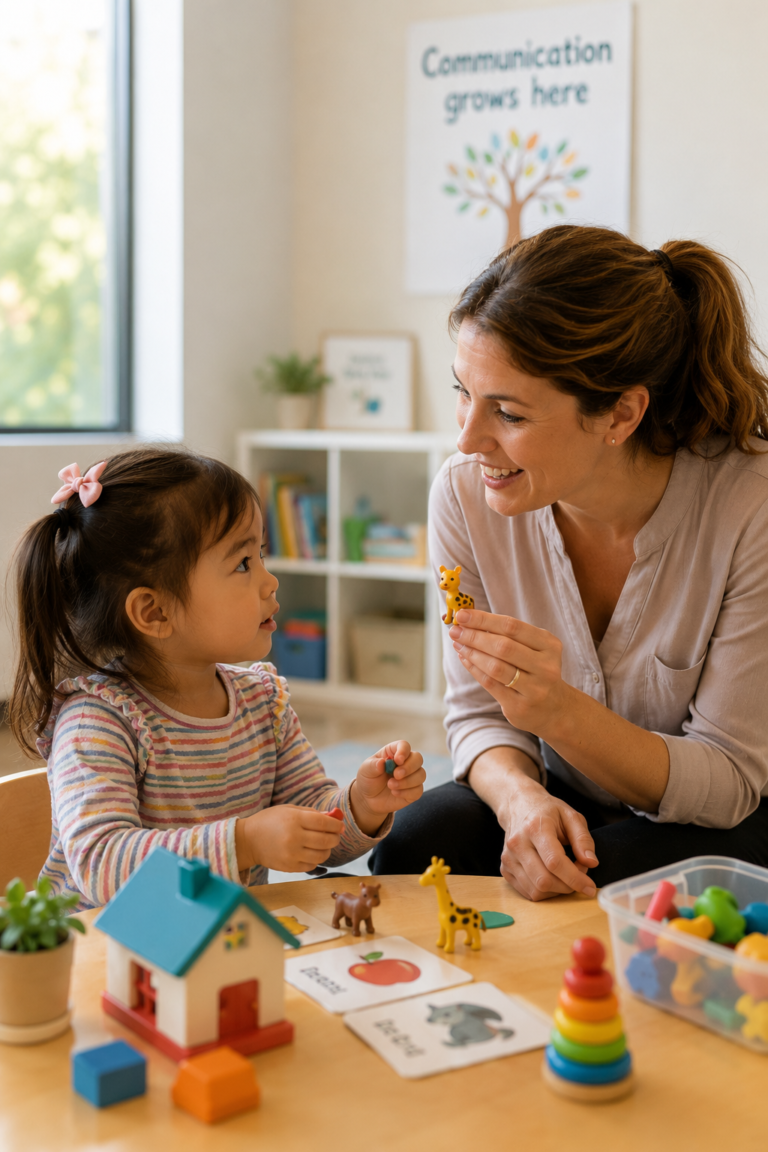
Speech-language professionals can help families understand what skills to encourage at home while also monitoring developmental progress more objectively. Even when therapy is not immediately recommended, having a clear plan can reduce ongoing anxiety.
Most importantly, children develop best within warm, responsive relationships. Feeling connected, supported, and engaged with caregivers remains one of the strongest foundations for communication growth at every stage.
Frequently Asked Questions
Is a late talker the same as a speech delay?
The distinction is not always obvious early on, which is why professional evaluations can sometimes help clarify developmental patterns and determine whether monitoring or intervention may be beneficial.
Do late talkers eventually catch up?
However, not every late talker catches up independently. Some children continue needing speech-language support later, which is why ongoing developmental monitoring remains important.
Should I wait before seeking speech therapy?
Seeking information early can also reduce stress for families and help children access support sooner if it becomes beneficial later.
Can bilingual children be late talkers?
When evaluating bilingual children, professionals consider total communication skills across both languages rather than focusing on only one language environment.
What causes speech delays in toddlers?
Because communication development is complex, evaluations typically examine several developmental areas together rather than assuming one explanation immediately.
What can parents do at home to encourage speech?
The goal is not to pressure children to perform but to create enjoyable, connected opportunities for communication throughout daily life.
Not Sure Where Your Child Falls?
Answer a few questions and we’ll tell you whether their development
looks on track — or whether it’s worth talking to an SLP.
A Few Final Thoughts on Communication From 6 to 12 Months
It is common for parents to wonder whether their child is simply a late talker or whether a broader speech or language delay may be present. While these terms are sometimes used interchangeably, they do not always describe the same developmental profile. Looking at your child’s understanding, gestures, play skills, and overall communication provides a much clearer picture than counting words alone.
Many children who are late talkers make steady progress over time, especially when they have strong understanding of language and continue to develop social communication skills. Other children benefit from an early speech and language evaluation to better understand their strengths and determine whether intervention would be helpful.
If you are concerned about your child’s communication, trust your instincts. Seeking guidance does not automatically mean your child needs therapy, but it can provide reassurance, practical strategies, and a clear plan for supporting communication at home.
Want to learn more? The American Speech-Language-Hearing Association (ASHA) provides helpful information about late language emergence, including typical development, evaluation, and early intervention.