
Lisps in Children: Types, Causes, and Treatment
A lisp happens when tongue placement or airflow changes the way certain speech sounds are produced. You might hear “sun” sounding more like “thun,” or you may notice that an /s/ sounds unusually wet, slushy, muffled, or distorted. Although we often talk about “a lisp” as if it were one thing, several different speech patterns can create these sounds.
Some tongue-forward errors can occur while a young child’s speech system is still developing. Other patterns, particularly lateralized or unusual distortions, are not generally considered typical developmental substitutions. That distinction is one reason a child’s age alone does not tell the whole story about whether treatment is appropriate.
Understanding the type of lisp your child has can make the situation much less confusing. Below, we’ll look at the four commonly described types of lisps, what may contribute to them, how speech-language pathologists evaluate and treat these speech patterns, and when it may be helpful to ask for professional guidance.
Understanding the Four Types of Lisps
Interdental or Frontal Lisp
An interdental lisp, often called a frontal lisp, occurs when the tongue moves forward between the front teeth while a child produces sounds such as /s/ and /z/. Instead of directing a narrow stream of air forward, the tongue position changes the sound. As a result, “sun” may sound something like “thun,” and “zoo” may have a similar tongue-forward quality.<br><br>
This is probably the type of lisp most parents picture when they hear the word “lisp.” Tongue-forward productions can occur during early speech development, so hearing this pattern in a younger preschooler does not automatically mean that a child has a speech disorder or needs immediate treatment.<br><br>
As children get older, however, /s/ and /z/ productions generally become more accurate. If the tongue-forward pattern persists, affects intelligibility, or is noticeable enough that your child becomes frustrated or self-conscious, an evaluation can help determine whether it is time to work on a different tongue position.
Lateral Lisp
Unlike a developmental tongue-forward substitution, lateral airflow is not generally considered a typical stage children need to pass through while learning /s/ and /z/. A child may continue using that movement pattern unless they learn a different way to direct the airflow.
Speech therapy for a lateral lisp therefore often concentrates on helping the child recognize the difference between the old and new sound, establish an appropriate tongue shape, and learn to send the air forward rather than out the sides. Once the child can produce the sound accurately, practice gradually moves into everyday speech.
Dentalized and Palatal Lisps
A palatal lisp involves an atypical tongue placement farther back toward the hard palate. It can create a noticeably distorted /s/ or /z/, but parents may have difficulty identifying exactly what the tongue is doing simply by listening. That is perfectly understandable; even speech patterns that sound similar can involve different tongue movements.
This is where an assessment by a speech-language pathologist can be particularly useful. Rather than treating every lisp the same way, the SLP listens to the distortion and examines how the child is positioning the tongue and directing airflow. Therapy can then target the movement pattern actually producing the error.

Why Do Some Children Develop a Lisp?
Speech Development and Learning New Sounds
The /s/ and /z/ sounds are not among the earliest English consonants children master. This helps explain why some preschool children may still show developing productions even when many other sounds are already clear. Development also varies from child to child, so one birthday should never be treated as an absolute deadline.
An SLP looks at much more than whether a child can say one sound correctly. The clinician considers the child’s overall speech system, consistency of the error, intelligibility, stimulability, age, communication needs, and whether the speech pattern is expected for the child’s language or dialect. Developmental expectations vary among children, which is why age, overall speech intelligibility, and the specific speech pattern all matter when determining whether concern is warranted.

Oral Habits, Teeth, and Tongue Position
Bite and dental alignment can also influence the space available for the tongue and the way airflow moves through the front of the mouth. When oral structure appears relevant, an SLP may consider whether input from a dentist, orthodontist, or another professional would be helpful rather than viewing the speech sound in isolation.
It is equally important not to blame the child. A lisp is not the result of laziness, carelessness, or a child simply refusing to “say the word right.” Speech movements become habitual through repetition, and changing an established movement pattern usually requires learning and practicing a new one.
How a Lisp Can Affect Everyday Communication
For other children, the distortion is more noticeable. A lisp may combine with other speech sound errors and make the child harder to understand, or a child may begin noticing that their speech sounds different from their peers. Occasionally children become reluctant to say particular words, read aloud, or speak in situations where they worry others will comment on their speech.
These functional effects matter. Decisions about speech therapy should consider not only the sound itself but also how communication is affecting the child at home, at school, and socially. The goal is not perfect speech for its own sake; it is helping a child communicate effectively and comfortably.
How Speech Therapy for Lisps Works
What Happens During a Speech Evaluation?
A speech evaluation starts with listening. The speech-language pathologist may ask your child to name pictures, repeat words, talk about familiar topics, or simply have a conversation. Hearing the child across different speaking situations helps the clinician identify which sounds are affected and whether the errors occur consistently.
The SLP may also look at the lips, tongue, teeth, jaw, palate, and oral movements that support speech. Developmental history, hearing, intelligibility, other speech errors, and the family’s concerns may all be considered. For multilingual children, speech should be considered within the child’s languages and linguistic background rather than comparing every difference with mainstream American English.
An evaluation does not automatically lead to therapy. Sometimes the recommendation is treatment; sometimes it is monitoring; and sometimes parents simply leave with a better understanding of what they are hearing. The purpose is to determine what is happening and what, if anything, would be useful next.
Learning a Clearer /S/ and /Z/
Once the child can produce the sound successfully, therapy becomes progressively more challenging. Practice may move from the sound by itself to syllables and words, then into phrases and sentences. Eventually, the focus shifts toward using the new production naturally during conversation without having to stop and think about it.
That progression matters because producing one excellent /s/ while watching a therapist is very different from using hundreds of accurate /s/ sounds while talking with friends. Establishing the sound, generalizing it to increasingly complex speaking situations, and making it automatic are important parts of speech sound treatment.
Practice at Home Without Constantly Correcting Speech
Try to keep practice predictable and positive. Work on the level your child’s SLP recommends rather than jumping immediately into conversation. A child who has just learned a clear /s/ by itself may not yet be ready to use that sound accurately in every word, sentence, and spontaneous conversation.
Most importantly, let your child’s therapist guide the specific technique. Different lisps involve different tongue positions and airflow patterns, so a strategy that is useful for one child may not be appropriate for another. Home practice works best when it reinforces the movement pattern being taught in therapy.
When Should You Seek Help for a Child's Lisp?
Age Is Helpful, but It Is Not the Only Factor
A younger child with a mild tongue-forward production may be monitored differently from a child with pronounced lateral airflow, multiple speech sound errors, or speech that is difficult for unfamiliar listeners to understand. An SLP can also consider whether your child can produce a clearer sound when shown how, which can provide useful information when planning next steps.
You do not have to wait until a particular birthday if you are concerned. An evaluation can provide information even when treatment is not yet recommended, and asking an SLP a question does not commit your child to months of therapy.
Common Reasons Families Seek an Evaluation
- A frontal or interdental lisp that continues as your child gets older
- A lateral, slushy, or wet-sounding /s/ or /z/
- A dentalized or unusual distortion that does not seem to be improving
- Several speech sounds that are difficult for your child to produce
- Speech that unfamiliar listeners frequently have trouble understanding
- Frustration, embarrassment, teasing, or avoidance related to speech
- Concerns raised by your child’s teacher, pediatrician, dentist, or another caregiver
- Questions about whether dental structure, hearing, or oral habits may be contributing
Finding the Right Next Step
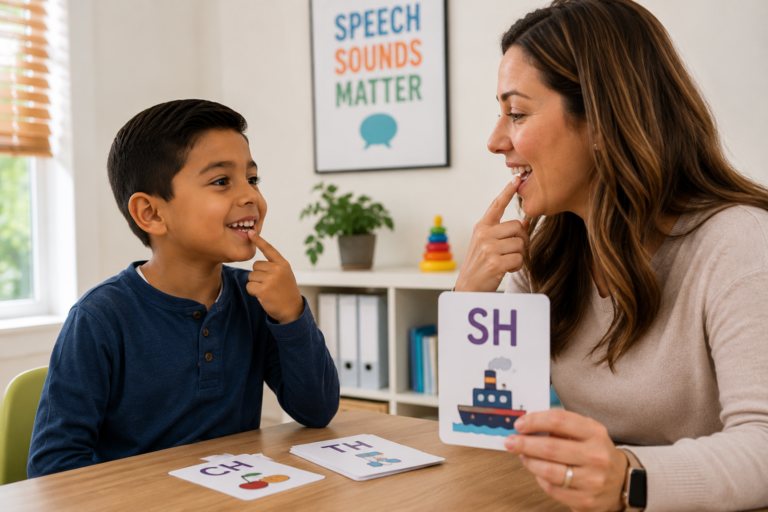
Depending on the findings, the SLP may recommend therapy, periodic monitoring, home guidance, or consultation with another professional. Treatment decisions should reflect the child’s individual speech pattern, age, intelligibility, communication needs, and how much the difference is affecting daily life.
The most useful question is often not simply, “Does my child have a lisp?” but, “How is my child’s speech developing, and would support be helpful right now?” A thoughtful evaluation can give families a much clearer answer. Image Placement: Beside or directly beneath the evaluation call-to-action
Want to learn more? The American Speech-Language-Hearing Association (ASHA) provides additional information about speech sound disorders, including articulation differences such as lisps and how speech-language pathologists evaluate and treat them.
Frequently Asked Questions About Lisps in Children
What is a lisp in a child?
A lisp is a speech sound error that affects how a child says certain sounds, most often /s/ and /z/. These sounds may come out distorted, unclear, or different from what listeners expect.
Some lisps are part of early speech development, but a lisp that continues as a child gets older may benefit from support from a speech-language pathologist.
What are the different types of lisps?
Lateral and palatal lisps are usually less typical speech patterns and often need direct speech therapy. Knowing the type of lisp helps guide the best treatment approach.
At what age should a child outgrow a lisp?
If a lisp continues past about age 4½ to 5, or if your child is hard to understand, it may be a good idea to schedule a speech evaluation.
What causes a lisp in children?
A lisp does not always mean something serious is going on. A speech-language pathologist can look at your child’s speech, mouth structure, and overall communication to better understand what may be contributing.
Can a lisp be corrected with speech therapy?
Progress is often strongest when therapy practice is simple, consistent, and supported at home. With the right guidance, many children become much clearer and more confident speakers.
Should I be concerned if my child has a lisp?
Getting support does not mean something is wrong with your child. It simply gives you a clearer picture of their speech development and what kind of help, if any, would be most useful.
Not Sure Where Your Child Falls?
Answer a few questions and we’ll tell you whether their development
looks on track — or whether it’s worth talking to an SLP.
A Few Final Thoughts on Lisps in Children
At the same time, not every lisp follows the same developmental path. Frontal, dentalized, lateral, and palatal lisps involve different tongue or airflow patterns, which is why identifying the type of distortion can be more useful than simply labeling all unclear /s/ sounds as a lisp.
If the lisp persists, sounds unusual, affects intelligibility, or begins bothering your child, a speech-language pathologist can take a closer look. An evaluation can tell you whether treatment is appropriate now, whether monitoring makes sense, and what you can do at home without turning normal conversation into constant speech practice.
Most of all, keep the focus on communication. Clearer speech can be an important therapy goal, but your child’s ideas, personality, and willingness to communicate matter just as much. The right support should help your child become a more comfortable and effective communicator—not make them afraid of getting every sound perfect.