
What Is AAC? A Parent-Friendly Guide
If you have heard a speech therapist, teacher, doctor, or early intervention provider mention AAC, it is very normal to feel unsure about what it means. Many parents hear the term for the first time when they are already worried about their child’s speech, and it can sound much bigger or more complicated than it really is.
AAC stands for augmentative and alternative communication. In everyday language, it means using tools, supports, gestures, pictures, signs, devices, or other ways to help a child communicate when spoken words are hard, limited, unclear, or not yet reliable. AAC may add to speech, or it may offer another way to communicate when speech is not available in the moment.
For many families, the biggest fear is that AAC will replace talking or make a child less motivated to speak. Research and speech-language pathology guidance do not support that fear. AAC can support communication, reduce frustration, and in many cases help spoken language grow because the child finally has a more successful way to share ideas.
This guide explains what AAC is, what it can look like, which children may benefit from it, and how families can think about AAC in a calm, practical way. The goal is not to pressure parents into one tool or one decision, but to help you understand AAC as a supportive communication option that can meet a child where they are.
Understanding What AAC Means for Children
AAC Is Communication Support, Not Giving Up on Speech
The word “augmentative” means AAC can add to a child’s speech. A child might say part of a word, point to a picture, gesture, and look at a parent all at the same time. The word “alternative” means AAC can also provide another way to communicate when speech is not enough or is not available.
This matters because communication is bigger than talking. Children communicate to ask for help, protest, greet people, make choices, share feelings, ask questions, and connect socially. AAC gives children more ways to do those things while speech and language skills continue developing.
What AAC Can Look Like in Everyday Life
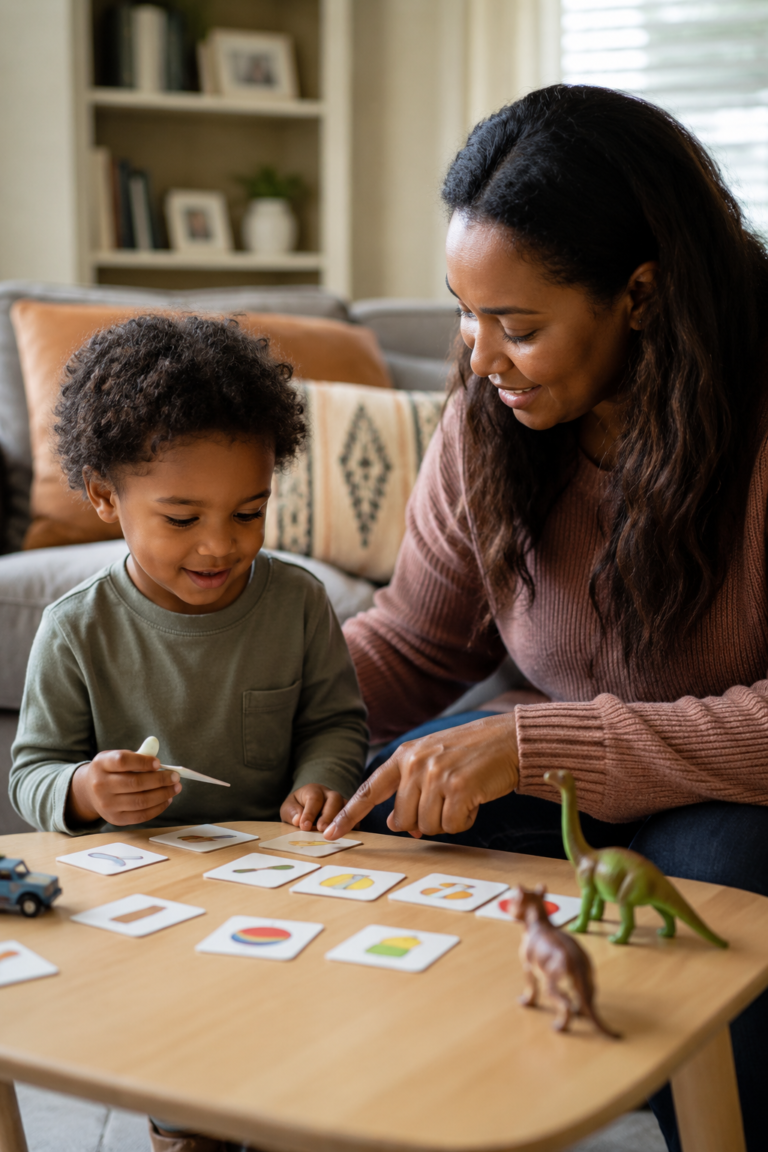
Some AAC systems are low-tech, such as picture cards, printed boards, or communication books. Others are high-tech, such as a tablet app or a dedicated speech-generating device. ASHA describes AAC as a broad range of tools and strategies that may support people with complex communication needs.
The best AAC system is not always the most expensive or advanced one. A helpful AAC system is one the child can access, understand, and use across real routines. That may mean snack time, playtime, bath time, preschool, therapy, family visits, or bedtime.
Why AAC Can Reduce Frustration
AAC can give a child a more reliable way to be understood. Instead of needing to produce a word on demand, the child may point, touch, show, choose, or activate a message. That success can change the emotional tone of daily routines for both the child and the family.
Over time, AAC may also help adults respond more consistently to the child’s message. When a child can show “help,” “stop,” “more,” “hurt,” or “play,” caregivers have clearer information. That clarity can support connection, independence, and confidence.
How AAC Supports Speech and Language Development
AAC Does Not Stop a Child From Talking
ASHA’s early intervention guidance notes that AAC does not hinder speech development and may support spoken language development in young children. Research has also found that AAC does not appear to slow speech and may enhance communication growth for some children.
A helpful way to think about AAC is that it lowers the pressure around talking. When a child can communicate successfully, they often have more chances to participate, hear language modeled, and connect meaningfully with others. Those experiences are valuable for language learning.

AAC Helps Children Learn the Power of Communication
For example, a child may touch “go” during a swing routine and then feel the swing move. They may tap “more” during bubbles and see the bubbles return. These small moments teach an important lesson: “My communication matters.”
This is especially important for children who have had many unsuccessful attempts to communicate. When adults respond warmly and consistently to AAC, children can begin to take more communication risks. That confidence can support both social interaction and language growth.
AAC Can Support Understanding, Not Just Expression
A parent might point to “bath,” “pajamas,” and “book” while talking through a bedtime routine. A therapist might model “want,” “help,” or “stop” on a device while playing. These visual and verbal models help connect words with actions, feelings, and routines.
Children develop communication at different rates, and developmental milestones are meant to guide observation rather than create panic. The CDC describes milestones as skills children often show as they grow in how they play, learn, speak, act, and move. AAC can be part of supporting that growth when a child needs more ways to communicate
Who Might Benefit From AAC?
AAC Can Help Children With Different Communication Needs
AAC is not only for one diagnosis, one age, or one type of child. It may support children with autism, childhood apraxia of speech, developmental delays, genetic conditions, motor speech challenges, cerebral palsy, hearing differences, or other communication needs. It may also support children whose speech is emerging but not yet reliable enough for daily communication.
Some children use AAC temporarily while speech is developing. Others use AAC long-term as part of how they communicate across life. Both situations are valid. The important question is not whether AAC is “too much,” but whether the child currently has enough ways to communicate what they want, need, think, and feel.
A child does not need to prove they are ready for AAC by meeting strict prerequisites. Modern AAC practice generally focuses on giving children access to communication while teaching them how to use it. Children learn communication through supported, meaningful use, not through waiting until everything is perfectly in place.
AAC May Be Helpful When Speech Is Limited or Hard to Understand
For a child with unclear speech, AAC does not erase their spoken attempts. Instead, it can give them a backup when the listener does not understand. A child might say something, point to a picture, and then try the word again. That combination can protect the child’s message while speech clarity continues to develop.
For a child who uses speech inconsistently, AAC can offer communication when words are not available. This can be especially meaningful during transitions, sensory overload, medical visits, school routines, or moments of big emotion. Communication support should be available when children need it most, not only when communication is easy.
AAC Should Fit the Child and Family
Families also need support, not guilt. Parents are often learning AAC while also managing schedules, appointments, school communication, behavior concerns, and everyday family life. A good AAC plan should feel doable enough to begin, even if it grows over time.
Speech-language pathologists can help families choose and adjust AAC supports based on the child’s communication needs, motor abilities, vision, hearing, language level, sensory preferences, and daily environments. The goal is a communication system that helps the child participate more fully, not a perfect-looking system that sits unused.
When to Seek Help or Support for AAC
Trust Your Concern, Even If You Are Not Sure Yet
A speech-language pathologist can look at the whole child, not just the number of words they say. That includes how your child understands language, uses gestures, plays, makes choices, responds socially, imitates actions, handles routines, and repairs communication breakdowns.
Seeking help does not mean you are giving up on speech. It means you are giving your child more access to communication now. Early support can help families respond with more confidence and reduce the wait-and-worry cycle.
Signs Your Child May Benefit From AAC Support
- Your child has very few spoken words for their age.
- Your child tries to talk, but most people cannot understand them.
- Your child becomes very frustrated when they cannot communicate.
- Your child often pulls, cries, grabs, or screams instead of being able to show what they want.
- Your child has a diagnosis or developmental profile that affects communication.
- Your child can say some words but does not use them consistently across settings.
- Your child seems to understand more than they can express.
- Your child needs support communicating at preschool, daycare, therapy, or medical appointments.
What an AAC Evaluation May Include
What an AAC Evaluation May Include

The evaluation may include trying different types of AAC, such as picture boards, signs, communication books, or speech-generating devices. The therapist may also look at how adults can model AAC naturally, because children usually learn AAC best when people around them use it too.
The first AAC system does not have to be the final AAC system. Children grow, needs change, and communication tools can be adjusted. What matters most is giving the child a reliable way to communicate while continuing to support speech, language, connection, and independence.
Frequently Asked Questions About AAC
What is AAC in speech therapy?
A speech-language pathologist may use AAC to help a child request, protest, comment, answer, ask questions, and connect with others. AAC is not separate from language therapy; it can be part of building stronger communication.
Will AAC stop my child from talking?
Many children use speech and AAC together. A child may say a sound, point to a picture, use a gesture, or press a message on a device. All of those attempts can be honored as communication.
Is AAC only for autistic children?
Autistic children may benefit from AAC, but AAC is not limited to autism. The main question is whether the child needs more reliable ways to express themselves and be understood.
Does my child need to be a certain age to start AAC?
Young children learn communication through repeated, meaningful experiences. When AAC is introduced in a playful and supportive way, it can become part of how adults help the child understand and use language.
What is the difference between low-tech and high-tech AAC?
One is not automatically better than the other. Many children use a combination, and the best choice depends on the child’s access, needs, environments, and communication goals.
How can parents support AAC at home?
You do not have to do it perfectly. The most important things are keeping AAC available, modeling it without pressure, responding to your child’s attempts, and celebrating communication in all its forms.
Not Sure Where Your Child Falls?
Answer a few questions and we’ll tell you whether their development
looks on track — or whether it’s worth talking to an SLP.
A Few Final Thoughts on AAC and Your Child’s Communication
AAC can feel like a big step at first, but at its heart, it is about something very simple: helping a child communicate. When children have more ways to share their needs, feelings, choices, and ideas, daily life can feel less frustrating and more connected.
Choosing AAC does not mean you are closing the door on speech. For many children, AAC opens the door to more communication while speech and language continue to develop. It gives adults another way to model words, respond to attempts, and help the child feel understood.
Your child’s communication does not have to look exactly like another child’s to be meaningful. A point, sign, picture, sound, word, device message, facial expression, or gesture can all carry real meaning when the people around the child are watching and listening.
If you are wondering whether AAC could help your child, that question is worth exploring with a speech-language pathologist. You do not need to have all the answers before beginning. You only need to start from the belief that your child deserves a reliable way to be heard.
Want to learn more? ASHA explains augmentative and alternative communication (AAC), including the different types of communication systems and who may benefit from them.