
Music Activities to Encourage Speech at Home
Music activities to encourage speech do not need to involve special instruments, expensive classes, or a parent with a perfect singing voice. Everyday songs, clapping games, dancing, homemade instruments, and playful pauses can all create natural opportunities for listening, imitation, turn-taking, gestures, sounds, and words.
It is also important to keep expectations realistic. Singing songs does not guarantee that a child will suddenly begin talking, and music is not a replacement for an evaluation or speech therapy when support is needed. Children develop communication skills in different ways and at different rates, and the most helpful activities are usually those that feel enjoyable and connected rather than pressured.
In this guide, we will look at why music can support communication, simple music activities families can use at home, and ways to adjust those activities for babies, toddlers, and preschoolers. We will also talk about signs that may be worth discussing with a pediatrician, early intervention provider, or speech-language pathologist.
Why Music Activities Can Support Speech and Language Development
Repetition Helps Children Learn What Comes Next
Familiarity can also make it easier for a child to participate. At first, a toddler may only watch during a favorite song. Later, the child might smile before a funny part, move a hand during a gesture, make one sound, or attempt a familiar word. Participation often develops gradually, and these early responses are meaningful forms of communication.
Parents do not need to repeatedly tell a child to say a word. Instead, sing the familiar song naturally and leave occasional opportunities for participation. When a child is ready, the predictability of the routine may make it easier to join with a movement, sound, word, or look.
Rhythm Can Make Communication Feel Predictable
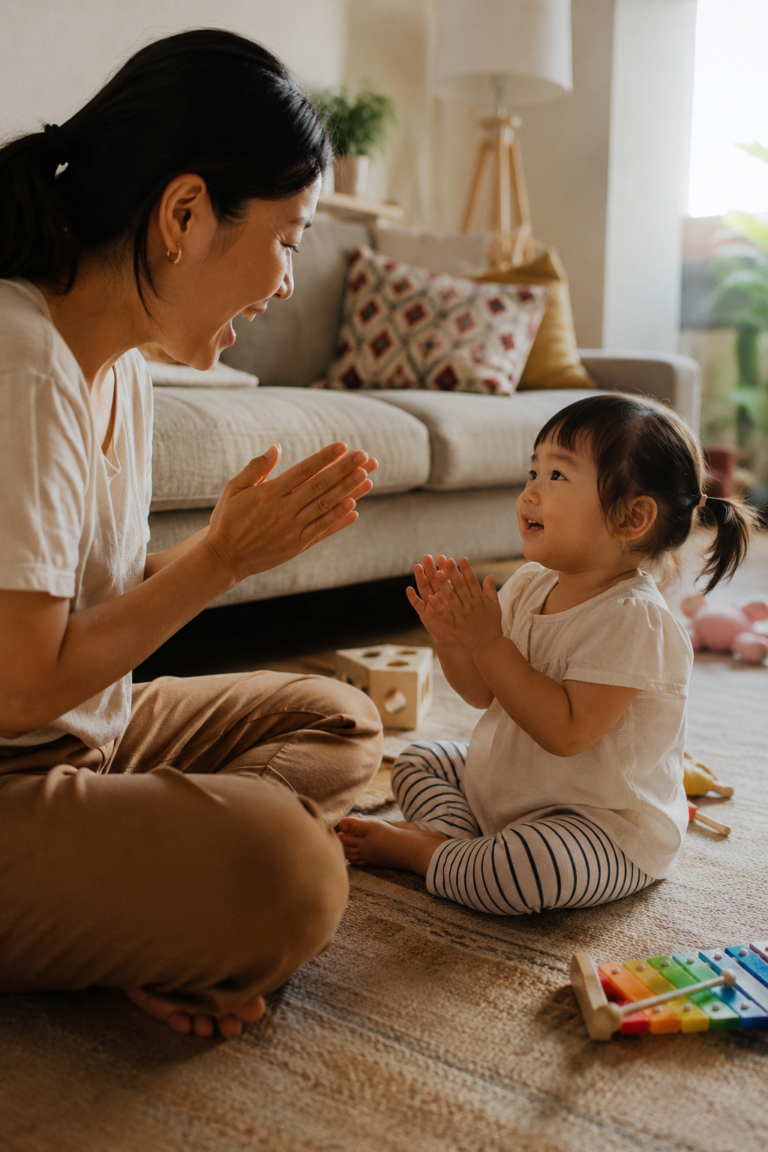
Think about a simple clapping pattern. You clap twice, pause, and look toward your child. Even without words, that activity can become a back-and-forth exchange. Your child may clap, smile, vocalize, reach for your hands, or signal that they want you to continue. These are all opportunities to build the foundations of communication.
Over time, words can be added to these rhythmic games. A parent might say “clap, clap, stop,” “go, go, go,” or “tap the drum.” Simple, repeated language is often easier for young children to notice and gives them useful words connected to an action they can see and feel.
Music Creates Natural Opportunities for Interaction
This is why singing together is different from simply playing songs in the background. Recorded music can certainly be enjoyable, but a live interaction allows a parent to slow down, repeat a favorite part, follow the child’s interest, change facial expressions, and respond immediately to the child’s communication attempts.
The goal is not to keep the child perfectly focused for an entire song. Some toddlers dance for ten seconds and then run across the room. Others watch quietly without singing. Follow the communication that is actually happening rather than trying to create a perfect activity.
Simple Music Activities to Encourage Speech at Home
Pause During a Favorite Song
For example, you might sing most of a familiar song and pause briefly before a favorite action or repeated word. Wait with an interested expression rather than saying, “What comes next?” Your child may fill in a word, make a sound, perform the gesture, smile, or look toward you. Any of these responses can continue the interaction.
When your child responds, keep the song going. There is no need to correct pronunciation or require a clearer attempt. The reward for participating is that the fun interaction continues. This makes communication feel powerful and meaningful rather than like a performance.
Add Gestures and Movement to Songs
Choose movements that are simple and easy to repeat. You might wave, clap, stomp, jump, point up, pretend to sleep, or make toy animals move while singing. Use the same words with the same actions often enough for the routine to become familiar, but keep your energy relaxed and playful.
As your child becomes comfortable, notice which parts they enjoy most. A toddler who repeatedly asks for the jumping part is communicating a preference. You can model simple language around that interest, such as “jump,” “more jumping,” or “jump again,” without requiring the child to repeat your words.
Make Music With Everyday Objects
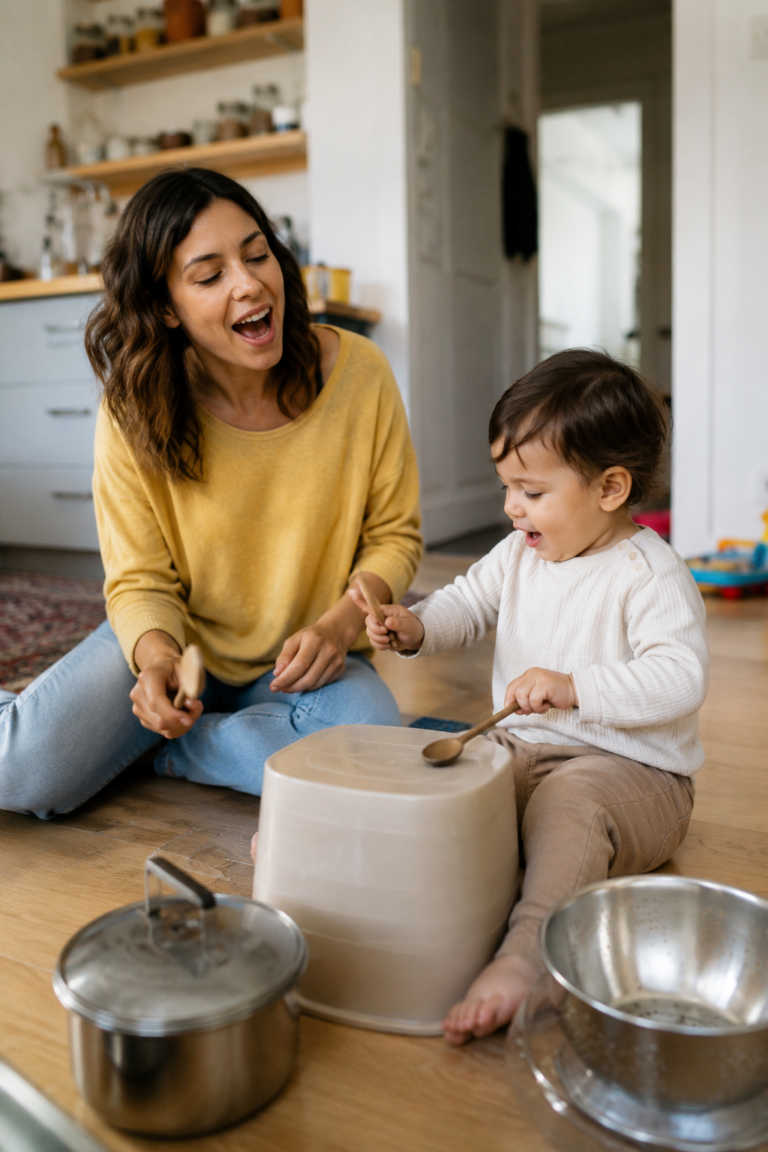
You do not need a collection of children’s instruments to create a useful music activity. A wooden spoon and an upside-down container can become a drum. A tightly sealed child-safe container can become a shaker. Hands can clap, feet can stomp, and fingers can tap on a table.
The activity becomes a language opportunity when you add simple words connected to what is happening. Try words such as “tap,” “bang,” “shake,” “go,” “stop,” “fast,” “slow,” “loud,” and “quiet.” You do not need to use all of these at once. Choose a few useful words and repeat them naturally during play.
Follow your child’s actions whenever possible. When your child bangs the drum, you might say, “Bang, bang, bang!” If the child suddenly stops, you can say, “Stop!” This kind of language describes what the child is already interested in, which can make the words more meaningful.
Need ideas for songs to use? Explore Songs Speech Therapists Actually Recommend for simple favorites that naturally encourage participation and early language.
How to Make Songs for Speech Development More Interactive
Use Simple Language Around the Music
Parents sometimes feel they need to talk constantly to help language grow. In reality, children often benefit from language that is connected to what they are doing and easy to understand. During music play, short comments can be especially useful because the action already provides meaning.
For a toddler using few or no words, you might model “go,” “stop,” “more,” “again,” “shake,” or “drum.” A child already combining words might hear slightly longer models such as “shake it fast,” “more music,” “Daddy is dancing,” or “the drum is loud.” Match your language roughly to what your child can understand while still giving them something new to hear.
There is no need to make a child repeat each phrase. Model the words while enjoying the activity together. Language learning happens across many interactions, not from successfully repeating every word on command.
For more ideas about using songs throughout everyday routines, read How Singing Helps Toddlers Learn First Words.
Follow Your Child’s Favorite Songs and Sounds
Watch for the parts that make your child light up. Perhaps they love animal sounds, a dramatic “boom,” a fast dance section, or a song about a favorite truck. Use that interest as the starting point for language. A child who loves a song about cars may hear and use words such as “car,” “go,” “stop,” “fast,” “beep,” and “again.”
It is perfectly fine to change lyrics or make up your own songs. Singing about putting on shoes, washing hands, cleaning up toys, or finding the family dog can make language part of a familiar routine. Your homemade songs do not need to rhyme or sound polished to be engaging.
Leave Space for Your Child to Take a Turn
After singing or making a musical sound, wait for a moment and watch your child. You may notice a look, gesture, body movement, vocalization, sign, picture selection, or spoken word. Respond to the communication your child is using rather than waiting only for speech.
This matters for children who communicate in different ways, including children who use gestures, signs, pictures, or augmentative and alternative communication, often called AAC. Music activities can include all forms of communication. A child does not have to speak aloud for a musical interaction to become a meaningful communication exchange.
When Music Activities Are Not Enough: Knowing When to Seek Support
Music Should Support Communication, Not Become a Test
Look at your child’s overall communication development rather than one isolated skill. Consider how your child communicates wants and needs, shares interests, understands language, uses gestures or other communication methods, and develops new skills over time. Developmental milestone guidance is most useful as a way to notice patterns and start conversations, not as a rigid scorecard. ld who does not sing along is not automatically showing a speech or language delay. At the same time, a favorite-song activity should not be used to dismiss broader concerns. Parents know their children well, and persistent worries are worth discussing with a qualified professional.
Signs It May Be Time to Ask About Speech and Language Development
- Your child is not meeting expected communication milestones for their age.
- Your child has lost words, gestures, social communication skills, or other abilities they previously used.
- Your child rarely attempts to communicate wants, needs, or interests using speech, gestures, signs, pictures, or another communication method.
- Your child seems to have difficulty understanding everyday language or following directions expected for their developmental level.
- Your toddler is using fewer words or word combinations than expected and is not steadily adding new communication skills.
- Your child is frequently frustrated because it is difficult for others to understand what they are trying to communicate.
- You have concerns about hearing, inconsistent responses to sound, or a history of frequent ear problems.
- Your instincts continue to tell you that your child may need additional support.
What a Speech-Language Pathologist Can Help You Understand
The purpose of seeking support is not to blame parents or take away the activities a family already enjoys. In many cases, an SLP can help caregivers recognize the communication opportunities already happening during play, books, meals, bath time, music, and other familiar routines.
Early questions are worth asking. The CDC encourages families to monitor development and act when children are missing milestones, have lost skills, or when caregivers have concerns. A professional can help determine whether monitoring, a hearing evaluation, early intervention, a speech-language evaluation, or another next step may be appropriate. nt: Within the support section, preferably beside the first or third H3 on desktop and stacked beneath it on mobile
Frequently Asked Questions About Music and Speech Development
Can music really help a toddler learn to talk?
Music should be viewed as one supportive part of a child’s communication environment rather than a cure for a speech or language delay. ASHA includes songs, rhymes, everyday conversation, vocabulary-building activities, and shared interaction among ways families can support communication and early literacy skills at home. the best songs to encourage toddler speech?
Should I pause during songs and wait for my child to fill in the word?
The pause should feel inviting rather than like a test. A child may say the word, approximate part of it, make the gesture, use a sign, select something on an AAC system, smile, or make an excited sound. Accept the response and continue the fun.
What if my child loves songs but does not talk?
Do recorded songs and music videos help speech as much as singing together?
Music does not have to be screen-based to be interesting. When recorded music is used, joining your child by dancing, copying movements, commenting, and taking turns can make the experience more interactive and create more opportunities for communication.
How often should we do music activities for speech development?
Pay attention to your child’s engagement rather than the clock. A few minutes of warm back-and-forth interaction can be more meaningful than continuing an activity after a child has lost interest. Music activities should fit naturally into family life, not become another source of pressure.
How often should we do music activities for speech development?
Pay attention to your child’s engagement rather than the clock. A few minutes of warm back-and-forth interaction can be more meaningful than continuing an activity after a child has lost interest. Music activities should fit naturally into family life, not become another source of pressure.
Not Sure Where Your Child Falls?
Answer a few questions and we’ll tell you whether their development
looks on track — or whether it’s worth talking to an SLP.
A Few Final Thoughts on Using Music to Encourage Speech
Music can turn an ordinary part of the day into a shared communication moment. A silly bath song, a round of clapping, or an enthusiastic dance in the kitchen may look simple from the outside, but it can create opportunities for attention, anticipation, imitation, gestures, sounds, words, and connection.
Try not to measure the success of a music activity by how many words your child says. A look that asks you to continue, a hand reaching for the drum, a copied movement, or an excited sound can all be part of a developing communication exchange.
Keep the experience playful. Sing familiar songs, make up your own, repeat what your child loves, and leave some quiet space for your child to take a turn. You do not need a special singing voice or a complicated home program to create meaningful interaction.
For more practical ideas about using everyday routines, music, and play to encourage communication, visit the Hanen Centre.
And when concerns remain, asking for professional guidance is a reasonable and caring step. Music activities can continue to be part of the fun while a speech-language pathologist or other qualified professional helps your family better understand your child’s individual communication strengths and needs.
Image Placement: Closing image beneath the final text or directly above the conclusion on longer desktop layouts