
What Is Teletherapy? A Parent-Friendly Guide to Online Speech Therapy
For many families, the idea sounds convenient but also raises questions. Parents may wonder whether a young child will actually interact with someone on a screen, whether therapy can still feel playful, or whether an online speech therapist can really understand what is happening with their child’s communication without being physically present.
Teletherapy can work very well for some children and some communication goals, but it is not automatically the right choice for every child. A thoughtful speech-language pathologist considers the child’s age, communication needs, attention, sensory and motor needs, family support, technology, and specific therapy goals before recommending online services. ASHA similarly describes telepractice as an individualized service-delivery option rather than a one-size-fits-all approach.
This guide explains what online speech therapy actually looks like, how therapists keep children engaged, where parents fit into the process, which children may benefit, and when an in-person or hybrid approach might make more sense.
How Online Speech Therapy and Teletherapy Work
What Teletherapy Means in Speech Therapy
The important distinction is that teletherapy is a way of delivering speech-language services. It is not a different profession or a simplified version of speech therapy. A licensed speech-language pathologist still evaluates communication needs, develops appropriate goals, chooses therapy strategies, monitors progress, and adjusts treatment based on how the child responds.
Depending on the child’s needs, online speech therapy may address language development, speech sounds, fluency or stuttering, social communication, literacy-related language skills, augmentative and alternative communication, and other communication concerns. Whether a particular goal is suitable for teletherapy depends on the individual child and the clinical judgment of the SLP.
What an Online Speech Therapy Session May Look Like
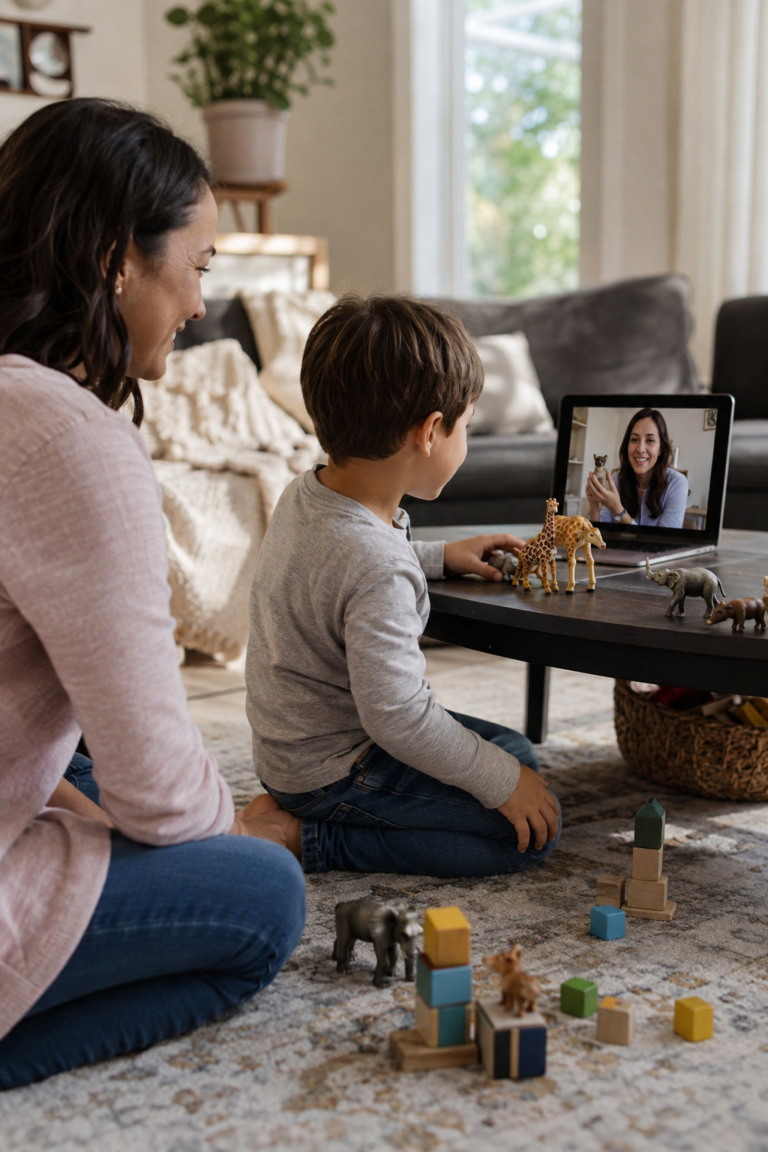
With a preschooler, for example, the therapist might ask a parent to bring out toy animals and then coach the parent in modeling words and short phrases while the child plays. A school-age child working on speech sounds might practice during a guessing game, conversation, reading activity, or interactive computer task rather than simply repeating a long list of words.
Good online therapy should still have a clear purpose behind the play. The activities may look casual to a parent watching from the side, but the SLP is making decisions about how much help to give, which communication behaviors to reinforce, when to model a word or sound, and how to create opportunities for the child to communicate more independently.
How Speech-Language Pathologists Adapt Therapy Online
The therapist may also involve a parent, teacher, aide, or other appropriately trained person who is physically with the child. In telepractice this person is sometimes called a facilitator. Their role might be as simple as helping a young child find a toy, repositioning the device, handling materials, or helping the therapist observe something more clearly.
Adaptation should continue throughout therapy. If a child consistently struggles to participate, if the technology interferes with accurate observation, or if the goals require support that cannot reasonably be provided remotely, an SLP may recommend changing the approach rather than continuing teletherapy simply because it is convenient.
Who May Benefit From Online Speech Therapy?
Teletherapy for Toddlers and Preschoolers
Parents sometimes assume toddlers are too young for teletherapy because they will not sit in front of a screen and follow instructions. That assumption comes from imagining online therapy as a miniature classroom lesson. Good early language intervention often looks very different because much of the therapist’s work may involve helping the caregiver create communication opportunities during play and everyday routines.
For a toddler, the SLP might watch a parent and child play with cars, bubbles, blocks, dolls, or snacks and suggest small changes in the way the parent talks or responds. The therapist may demonstrate how to model a short word, wait for the child to communicate, expand what the child says, or offer choices without turning interaction into a test.
This parent-coaching approach can be especially useful because families practice strategies with their own toys and routines rather than learning something in a clinic and trying to recreate it later. Still, some young children and families find remote sessions frustrating or difficult, and that information matters. A trial period can sometimes help an SLP and family decide whether teletherapy is sustainable. ASHA specifically notes that a trial may be useful in determining whether telepractice is an effective fit.

Online Speech Therapy for School-Age Children
School-age children may be able to participate more directly with an online therapist. Sessions can include conversation, reading, interactive games, visual materials, writing, speech practice, storytelling, problem solving, and other activities connected to the child’s treatment goals.
A child working on an /r/ sound, for example, might practice the sound in words and sentences and then use it during a game or conversation. A child receiving language therapy might work on understanding directions, organizing a story, learning new vocabulary, explaining ideas, or using more complex sentences in meaningful activities.
Attention still matters, but being active and engaged is more important than sitting perfectly still. A skilled teletherapist can change activities, build movement into the session, use visual schedules, involve the parent when useful, and adjust expectations when a child is tired or having an unusually difficult day.
When Virtual Therapy Can Make Speech Services Easier to Access
Teletherapy can also make scheduling easier for households juggling school, work, siblings, transportation, or medical appointments. Removing the commute does not eliminate every scheduling challenge, but it can make consistent attendance more realistic for some families. For children who feel comfortable at home, receiving therapy in a familiar space can also reduce some of the transition involved in going to a clinic.
Remote access does not mean that any therapist anywhere can automatically treat your child. Speech-language pathology licensing requirements are tied to location, and clinicians need to follow the laws that apply where services are being provided and where the client is located. ASHA advises clinicians to verify applicable state licensure requirements before beginning telepractice.
Benefits and Limitations of Online Speech Therapy
Convenience Is Helpful, but Quality Still Matters
Convenience alone, however, is not enough reason to choose a service. Parents should still expect individualized goals, clear explanations, appropriate progress monitoring, meaningful interaction, and opportunities to ask questions. The therapist should be able to explain why a particular activity is being used and how it relates to the child’s communication goals.
ASHA states that clinicians providing telepractice remain responsible for delivering safe, effective services and for determining whether clients are appropriate for remote care. Telepractice should meet the same professional expectations applied to in-person speech-language services.
Teletherapy Can Bring Parent Coaching Into Everyday Life
For younger children especially, the parent may become an important part of the session. Rather than expecting the therapist to create every communication opportunity through a screen, the SLP can coach the caregiver in real time. The parent gets to see what the strategy looks like, try it immediately, and receive feedback while interacting with their own child.
The goal is not to turn parents into therapists or give families another long list of assignments. Helpful coaching usually focuses on small changes that fit naturally into family life: pausing a little longer, modeling a simpler phrase, commenting instead of asking repeated questions, or following the child’s interests during play.
When In-Person or Hybrid Therapy May Be a Better Fit
Certain evaluations or treatment goals may benefit from direct physical access, specialized equipment, hands-on support, or observations that are difficult to obtain through a camera. Feeding and swallowing concerns, some motor-based needs, complex AAC needs, and situations involving safety may sometimes call for in-person assessment or a hybrid model, depending on the individual circumstances. ASHA notes that certain goals may require in-person support and that hybrid care can be useful when some goals translate better to telepractice than others.
Choosing in-person therapy does not mean teletherapy failed, just as choosing teletherapy does not mean a family is accepting a lesser form of care. The best service-delivery model is the one that allows the therapist to assess accurately, provide appropriate treatment, and help the child and family participate successfully.
When to Consider Online Speech Therapy or Additional Support
You Do Not Have to Know Whether Teletherapy Is the Right Choice Yet
An initial conversation or evaluation can help clarify what your child is doing well, where communication may be difficult, what goals might be appropriate, and whether those goals are realistic to address remotely. Some families begin online and later move to in-person services. Others use a hybrid approach or discover that teletherapy works better than they expected.
A good SLP should be comfortable discussing the limitations of virtual care as well as its strengths. If the therapist believes an accurate evaluation or appropriate treatment cannot be provided remotely, recommending another option is a sign of responsible clinical judgment rather than a reason for concern.
Signs It May Be Worth Talking With a Speech-Language Pathologist
- Your child is using noticeably fewer words or sentences than you expected for their age.
- Your child has difficulty understanding everyday language or following age-appropriate directions.
- Family members or other people frequently have difficulty understanding your child’s speech.
- Your child becomes frustrated because it is hard to communicate wants, needs, thoughts, or feelings.
- You are concerned about stuttering, voice, social communication, or another change in the way your child communicates.
- Your child has lost words or communication abilities they previously used.
- A teacher, pediatrician, caregiver, or other professional has suggested having speech or language skills evaluated.
- You simply have a persistent concern and would like professional guidance about what you are seeing.
What to Look for in an Online Speech Therapist

Ask how sessions are structured and what happens if online therapy is not working well. Parents should feel comfortable asking how goals are chosen, how progress will be measured, how often the plan will be reviewed, and whether the therapist ever recommends in-person assessment or treatment when needed.
Privacy is another appropriate question. Health care providers subject to HIPAA must follow applicable privacy and security requirements when providing telehealth, and additional state requirements may apply. HHS recommends secure technology as well as practical steps families can take, such as joining appointments from a private location and avoiding unsecured public networks when possible.
Frequently Asked Questions About Teletherapy
Is teletherapy the same thing as online speech therapy?
Whatever term a provider uses, parents should focus on who is providing the service, whether the therapist is appropriately licensed, whether the treatment is individualized, and whether remote care is appropriate for the child’s particular needs.
Can online speech therapy be as effective as in-person therapy?
Rather than asking whether teletherapy is universally better or worse, it is more useful to ask whether it is a good fit for your child. ASHA recommends that clinicians make this determination individually and modify or reconsider remote services when technology or participation interferes with appropriate care.
What age can a child start teletherapy?
Age is only one consideration. An SLP will also look at communication goals, attention, sensory and motor needs, family participation, available technology, and whether the therapist can adequately observe and support the child through the remote format.
Do parents need to participate during online speech therapy?
Older children may be able to participate more independently, although parents should still understand the goals and know how they can support communication outside therapy. The amount of involvement should be based on the child’s needs rather than a rule that applies to every family.
What equipment do we need for online speech therapy?
Reliable audio and video are clinically important because the therapist needs to hear speech accurately and observe the child. ASHA specifically identifies stable connectivity and appropriate audio-video equipment as important components of quality telepractice.
Does insurance cover teletherapy for speech therapy?
Before beginning therapy, ask both the SLP practice and your insurance company whether teletherapy is covered, whether a referral or prior authorization is required, and what your expected out-of-pocket responsibility will be. ASHA notes that payment and coverage for telepractice vary substantially among public and private payers.
Not Sure Where Your Child Falls?
Answer a few questions and we’ll tell you whether their development
looks on track — or whether it’s worth talking to an SLP.
A Few Final Thoughts About Teletherapy and Online Speech Therapy
For some children, online speech therapy becomes a natural part of the week. For others, in-person care provides the interaction, hands-on support, or clinical observation they need. Many families fall somewhere in between and may benefit from combining the two approaches.
You also do not have to determine the perfect format before asking for help. If you have questions about your child’s speech, language, fluency, social communication, or overall ability to communicate, an evaluation or consultation with an SLP can help you understand the options without committing you to one particular type of therapy.
Whether therapy happens at a clinic table or through a screen in your living room, the goal is the same: helping your child communicate more successfully in the relationships, routines, and everyday moments that matter.