Modeling vs. Prompting: What Works Better at Home?
When parents want to help a child talk, it is completely natural to ask questions such as, “What is this?” “Can you say ball?” or “Tell Grandma what you did today.” These prompts usually come from a loving place. You want to hear what your child knows, help them practice, and encourage more communication. But when we look at modeling vs. prompting, the most helpful approach at home is often not the one that asks children to perform the most.
Modeling means giving your child a useful word, phrase, or sentence without requiring them to repeat it. During snack time, you might say, “More crackers,” as your toddler reaches toward the box. During play, you might say, “Car goes fast!” as the car rolls down the ramp. Your child gets to hear language connected to something meaningful in the moment. ASHA encourages families to model words and language during everyday interaction, and language intervention research also supports responsive strategies such as expansions and conversational recasts. does not mean prompting is always wrong. A gentle choice such as, “Milk or water?” can create a natural opportunity to communicate. A familiar pause in a song may invite a child to fill in a word. The concern is usually not one individual prompt. It is the pattern that develops when most conversations begin to feel like questions, quizzes, or repeated requests to say something on command.
In this article, we will look closely at modeling vs. prompting, why speech-language pathologists often rely heavily on language models, when prompts can be helpful, and how parents can support communication during ordinary routines without turning home into a therapy session.
Modeling means giving your child a useful word, phrase, or sentence without requiring them to repeat it. During snack time, you might say, “More crackers,” as your toddler reaches toward the box. During play, you might say, “Car goes fast!” as the car rolls down the ramp. Your child gets to hear language connected to something meaningful in the moment. ASHA encourages families to model words and language during everyday interaction, and language intervention research also supports responsive strategies such as expansions and conversational recasts. does not mean prompting is always wrong. A gentle choice such as, “Milk or water?” can create a natural opportunity to communicate. A familiar pause in a song may invite a child to fill in a word. The concern is usually not one individual prompt. It is the pattern that develops when most conversations begin to feel like questions, quizzes, or repeated requests to say something on command.
In this article, we will look closely at modeling vs. prompting, why speech-language pathologists often rely heavily on language models, when prompts can be helpful, and how parents can support communication during ordinary routines without turning home into a therapy session.
Modeling vs. Prompting: Understanding the Difference
What Language Modeling Looks Like in Everyday Life
Language modeling is simply saying the words your child might find useful while you are already doing something together. You do not need flashcards, special toys, or a scheduled lesson. You are giving language to the moment. When your child points toward bubbles, you might say, “Bubbles!” “More bubbles,” or “Pop the bubbles.”
The most useful models are often short enough for the child to notice and connected to what has their attention. During bath time, you might say, “Water in,” “Wash toes,” or “Duck is swimming.” During a walk, you might notice, “Big truck,” “Dog running,” or “Bird up high.” The exact words matter less than creating repeated, meaningful opportunities to hear language in context.
This kind of responsive interaction fits with speech-language pathology approaches that follow a child’s interests and use strategies such as modeling, expansions, wait time, and recasting. Research on parent-implemented language intervention has found positive effects on children’s receptive and expressive language skills, although every child responds differently and individual needs still matter.
The most useful models are often short enough for the child to notice and connected to what has their attention. During bath time, you might say, “Water in,” “Wash toes,” or “Duck is swimming.” During a walk, you might notice, “Big truck,” “Dog running,” or “Bird up high.” The exact words matter less than creating repeated, meaningful opportunities to hear language in context.
This kind of responsive interaction fits with speech-language pathology approaches that follow a child’s interests and use strategies such as modeling, expansions, wait time, and recasting. Research on parent-implemented language intervention has found positive effects on children’s receptive and expressive language skills, although every child responds differently and individual needs still matter.
What Prompting Sounds Like
Prompting asks or encourages a child to produce a particular response. Some prompts are direct, such as, “Say cookie,” “What color is this?” or “Tell me what this is.” Others are more open and natural, such as pausing before a familiar word, offering a choice, or waiting expectantly after creating a communication opportunity.
Parents often use prompts because they want to know what their child can say. That is understandable. The difficulty is that knowing a word and producing it immediately on request are not exactly the same thing. A young child may recognize a word, understand the situation, and still not be ready to say that word at that moment.
Prompting can also vary greatly in how much pressure it creates. “Do you want apple or banana?” during snack time is different from asking a child five times to repeat “banana” before giving it to them. Looking at modeling vs. prompting is not about labeling every question as bad. It is about noticing whether communication still feels connected, responsive, and enjoyable.
Parents often use prompts because they want to know what their child can say. That is understandable. The difficulty is that knowing a word and producing it immediately on request are not exactly the same thing. A young child may recognize a word, understand the situation, and still not be ready to say that word at that moment.
Prompting can also vary greatly in how much pressure it creates. “Do you want apple or banana?” during snack time is different from asking a child five times to repeat “banana” before giving it to them. Looking at modeling vs. prompting is not about labeling every question as bad. It is about noticing whether communication still feels connected, responsive, and enjoyable.
Why Modeling Often Feels Easier for Children
Imagine trying to learn a new language while someone repeatedly points to objects and asks you to name them. Even when you know some answers, the interaction can start to feel like a test. Children may experience something similar when they are asked many questions in a row or frequently told to repeat words.
Modeling lowers that immediate performance demand. A child can watch, listen, gesture, vocalize, use part of a word, or say nothing at all while still participating in the interaction. The adult keeps providing useful language connected with the child’s focus.
Children also need opportunities to communicate spontaneously, not only after an adult asks a question. A strong home language environment leaves room for children to start interactions in their own way. That beginning might be a look, point, sound, gesture, word, or sentence depending on the child’s developmental level.
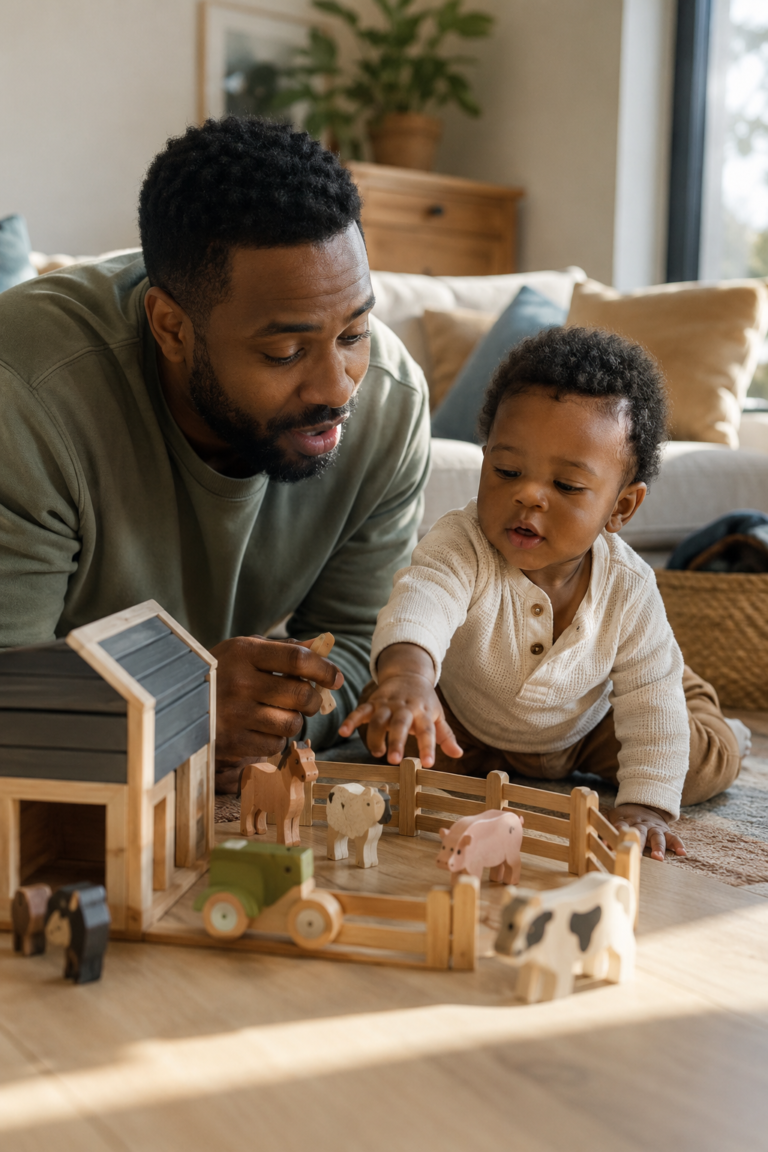
Modeling lowers that immediate performance demand. A child can watch, listen, gesture, vocalize, use part of a word, or say nothing at all while still participating in the interaction. The adult keeps providing useful language connected with the child’s focus.
Children also need opportunities to communicate spontaneously, not only after an adult asks a question. A strong home language environment leaves room for children to start interactions in their own way. That beginning might be a look, point, sound, gesture, word, or sentence depending on the child’s developmental level.
Why Modeling Language Can Be So Helpful at Home
Children Hear Words Connected to Meaning
Words are easier to understand when they are connected to something a child is already seeing, doing, feeling, or wanting. A toddler who is trying to open a container may be especially ready to hear words such as “open,” “help,” or “stuck.” Those words have an immediate purpose in that moment.
This is one reason following a child’s lead can be so useful. Instead of redirecting every interaction toward an adult-selected vocabulary word, you notice what has captured your child’s attention and add language there. When a child repeatedly pushes a train through a tunnel, you can model “Train in,” “Go through,” “It disappeared,” or other language that fits their current level.
Parents do not have to narrate every second of the day. In fact, constant talking can be overwhelming. The goal is to add clear, meaningful language and then leave room for the child to respond.
This is one reason following a child’s lead can be so useful. Instead of redirecting every interaction toward an adult-selected vocabulary word, you notice what has captured your child’s attention and add language there. When a child repeatedly pushes a train through a tunnel, you can model “Train in,” “Go through,” “It disappeared,” or other language that fits their current level.
Parents do not have to narrate every second of the day. In fact, constant talking can be overwhelming. The goal is to add clear, meaningful language and then leave room for the child to respond.
Modeling Can Grow With Your Child
One helpful feature of language modeling is that it can change as a child’s communication grows. For a child communicating mostly with gestures or sounds, a parent may model single words such as “up,” “go,” “help,” and “more.” For a child already using single words, the parent can model short combinations such as “more juice” or “Daddy home.”
For a child who says, “Dog run,” a parent might respond, “The dog is running!” This type of response keeps the child’s meaning while offering a slightly more complete model.
The important point for parents is simple: you can respond to what your child already communicates and gently add a little more. You do not need to correct every grammar mistake or insist that your child repeat the longer version. The model itself gives your child another opportunity to hear how language can work.
For a child who says, “Dog run,” a parent might respond, “The dog is running!” This type of response keeps the child’s meaning while offering a slightly more complete model.
The important point for parents is simple: you can respond to what your child already communicates and gently add a little more. You do not need to correct every grammar mistake or insist that your child repeat the longer version. The model itself gives your child another opportunity to hear how language can work.
Modeling Helps Conversation Stay Connected
Communication develops inside relationships. A child says or does something, another person responds, and the interaction continues. Modeling supports this back-and-forth rhythm because the adult’s language relates directly to what the child is doing or communicating.
For example, a child may point to the window and say, “Truck!” A parent could respond, “Yes, a big truck! It’s so loud.” The child might point again, make an engine sound, or add another word. The conversation grows from the child’s original message rather than shifting immediately into a quiz such as, “What color is the truck?”
Questions certainly belong in real conversations. The issue is balance. Children benefit from hearing comments, descriptions, reactions, ideas, and playful language—not only questions that require answers. Parents can support language simply by becoming a responsive communication partner during activities that are already happening.
For example, a child may point to the window and say, “Truck!” A parent could respond, “Yes, a big truck! It’s so loud.” The child might point again, make an engine sound, or add another word. The conversation grows from the child’s original message rather than shifting immediately into a quiz such as, “What color is the truck?”
Questions certainly belong in real conversations. The issue is balance. Children benefit from hearing comments, descriptions, reactions, ideas, and playful language—not only questions that require answers. Parents can support language simply by becoming a responsive communication partner during activities that are already happening.
When Prompting Can Still Be Useful
Gentle Prompts Can Create Communication Opportunities
Prompting is not something families need to eliminate. Used thoughtfully, prompts can help create a reason or an opening for communication. A parent holding two snacks might ask, “Cracker or strawberry?” A child could respond by pointing, looking, reaching, signing, using AAC, making a sound, or saying a word.
A good communication opportunity allows for different forms of response. This matters because communication is broader than spoken words alone. The adult can acknowledge the child’s message and then provide a verbal model: “Strawberry. You picked strawberry!” This keeps the interaction moving while still giving the child useful language.
Some children may benefit from more specific prompts as part of an individualized speech-language therapy plan. An SLP may use particular cues or prompting systems for specific speech, language, motor speech, or communication goals. Home strategies should match the child rather than applying one method rigidly to every child.
A good communication opportunity allows for different forms of response. This matters because communication is broader than spoken words alone. The adult can acknowledge the child’s message and then provide a verbal model: “Strawberry. You picked strawberry!” This keeps the interaction moving while still giving the child useful language.
Some children may benefit from more specific prompts as part of an individualized speech-language therapy plan. An SLP may use particular cues or prompting systems for specific speech, language, motor speech, or communication goals. Home strategies should match the child rather than applying one method rigidly to every child.
Pausing Can Be More Helpful Than Repeating the Question
One of the simplest changes parents can make is to ask once and then wait. Adults often underestimate how quickly they repeat, rephrase, or answer their own questions. A child may need extra time to understand the language, organize a response, and decide how to communicate.
You can also use predictable routines to create natural pauses. During “Ready, set…” you can pause before saying “go.” During a familiar song, you might stop before an expected word. These small pauses create an opportunity for the child to participate without turning the interaction into a demand.
The pause should feel like an invitation, not a standoff. When your child does not respond, simply provide the word and continue. For example, pause after “Ready, set…” and then cheerfully say, “Go!” The child still hears the model, and the game remains fun.
You can also use predictable routines to create natural pauses. During “Ready, set…” you can pause before saying “go.” During a familiar song, you might stop before an expected word. These small pauses create an opportunity for the child to participate without turning the interaction into a demand.
The pause should feel like an invitation, not a standoff. When your child does not respond, simply provide the word and continue. For example, pause after “Ready, set…” and then cheerfully say, “Go!” The child still hears the model, and the game remains fun.
The Goal Is Communication, Not Perfect Performance
It is easy to become focused on whether a child said the exact word you were hoping for. But meaningful communication can take many forms. A child who looks toward the refrigerator, reaches upward, signs “eat,” uses an AAC button, or says “nana” for banana is communicating something important.
Parents can acknowledge the message first and then model useful language. You might say, “Banana! You want a banana.” This approach shows the child that communication works while offering a slightly fuller example.
For many families, the best balance is to model much more often than they prompt. Think of modeling as the everyday foundation and prompting as one tool that can be used gently and purposefully. Home communication should still feel like family life, not a continuous therapy drill.
Parents can acknowledge the message first and then model useful language. You might say, “Banana! You want a banana.” This approach shows the child that communication works while offering a slightly fuller example.
For many families, the best balance is to model much more often than they prompt. Think of modeling as the everyday foundation and prompting as one tool that can be used gently and purposefully. Home communication should still feel like family life, not a continuous therapy drill.
When Modeling at Home May Not Be Enough
Trust Your Concerns About Communication
Every child develops communication skills in an individual way, and milestone ranges should be used thoughtfully rather than as a rigid test. At the same time, parents do not need to ignore a persistent concern or keep trying home strategies indefinitely when something does not feel right.
A child’s full communication profile matters. That includes how they understand language, use gestures, make sounds, combine words, interact socially, play, and respond to other people. One isolated skill does not tell the whole story, and a speech or language delay cannot be identified from a short list of symptoms alone.
Consider talking with your child’s pediatrician, an early intervention program, or a speech-language pathologist when you are concerned about how your child understands or uses communication. You do not have to determine the cause on your own before asking for professional guidance.
A child’s full communication profile matters. That includes how they understand language, use gestures, make sounds, combine words, interact socially, play, and respond to other people. One isolated skill does not tell the whole story, and a speech or language delay cannot be identified from a short list of symptoms alone.
Consider talking with your child’s pediatrician, an early intervention program, or a speech-language pathologist when you are concerned about how your child understands or uses communication. You do not have to determine the cause on your own before asking for professional guidance.
Signs It May Be Worth Asking for Professional Guidance
Parents may consider discussing a speech and language evaluation when they notice concerns such as:
- Very limited use of gestures, sounds, words, or other forms of communication for the child’s developmental stage
- Difficulty understanding familiar words or simple everyday directions
- Speech that is unusually difficult for familiar listeners to understand compared with developmental expectations
- Frequent frustration because the child has difficulty communicating wants, needs, or ideas
- Loss of previously used speech, language, or communication skills
- Concern about hearing or inconsistent responses to sound and spoken language
- A persistent feeling that communication development is not progressing as expected
An SLP Can Help Individualize the Strategy

A speech-language pathologist can look beyond the number of words a child says. An evaluation may consider how the child understands language, communicates wants and ideas, plays, interacts with others, uses sounds and words, and responds to different types of support.
The recommendation may include direct therapy, parent coaching, monitoring, additional assessment, or collaboration with other professionals depending on the child’s needs. The most useful home strategies are the ones chosen for that particular child rather than applied the same way to every family.
Parents should not feel blamed when a child has a speech or language delay. Modeling is a supportive strategy, not a guarantee and not a substitute for an evaluation when concerns are present. A good plan should help families understand how to support communication while respecting both the child and the realities of everyday family life.
The recommendation may include direct therapy, parent coaching, monitoring, additional assessment, or collaboration with other professionals depending on the child’s needs. The most useful home strategies are the ones chosen for that particular child rather than applied the same way to every family.
Parents should not feel blamed when a child has a speech or language delay. Modeling is a supportive strategy, not a guarantee and not a substitute for an evaluation when concerns are present. A good plan should help families understand how to support communication while respecting both the child and the realities of everyday family life.
Frequently Asked Questions
Is modeling better than asking my child to say words?
For everyday language support, modeling is often a better foundation than repeatedly asking a young child to say words. It lets the child hear useful language in meaningful situations without making every interaction depend on an immediate spoken response. ASHA encourages adults to model language and talk with children during shared activities and routines. does not mean you can never ask your child a question or invite them to try a word. A balanced approach usually includes plenty of natural models, comments, pauses, choices, and opportunities to communicate.
Should I stop saying, “Can you say...?”
You do not have to remove that phrase from your vocabulary completely, but it is helpful to notice how often you use it. When “Can you say…?” appears repeatedly throughout the day, some children may become less engaged or begin waiting for adults to direct each communication attempt.
Try replacing some repetition requests with a simple model. Instead of “Can you say bubbles?” several times, say, “Bubbles! More bubbles. Pop!” Then pause and see how your child responds.
What should I do when my child points instead of talking?
Respond to the point as meaningful communication and add language that fits the situation. For example, when your child points to the shelf, you might say, “You want the car. Car, please,” while helping them continue the interaction.
Gestures are part of early communication development, and spoken language is not the only way a child can send a message. CDC milestones include gestures such as pointing and other nonverbal communication behaviors alongside speech and language milestones. should I wait after asking a question? There is no single perfect number of seconds for every child, but waiting longer than feels natural to an adult can sometimes give a child more opportunity to process and respond. Watch your child rather than silently counting through every interaction.
During the pause, stay relaxed and interested. When there is no response, model the answer naturally and keep the activity moving rather than repeating the same question again and again.
Gestures are part of early communication development, and spoken language is not the only way a child can send a message. CDC milestones include gestures such as pointing and other nonverbal communication behaviors alongside speech and language milestones. should I wait after asking a question? There is no single perfect number of seconds for every child, but waiting longer than feels natural to an adult can sometimes give a child more opportunity to process and respond. Watch your child rather than silently counting through every interaction.
During the pause, stay relaxed and interested. When there is no response, model the answer naturally and keep the activity moving rather than repeating the same question again and again.
Is it okay to ask my toddler questions?
Yes. Questions are a normal and important part of conversation. The goal is not to stop asking them, but to balance questions with comments, descriptions, playful sounds, reactions, and language models.<br><br>
You might notice your own pattern during five minutes of play. When nearly every sentence is a question, try making several comments about what your child is doing before asking another question.
What if my child can say a word but refuses to repeat it?
A child may use a word spontaneously but not produce it on request, and that does not necessarily mean the child has forgotten the word. Communication is affected by motivation, attention, context, comfort, and the demands of the moment.
Acknowledge what your child communicates and keep providing natural opportunities to hear and use the word. Persistent concerns about a child’s overall speech or language development are better addressed through a full developmental discussion or speech-language evaluation than by repeatedly testing individual words.
Can modeling help a child with a speech or language delay?
Modeling can be part of an effective language-support plan, and research on parent-implemented intervention and conversational language strategies supports the value of responsive adult interaction. However, modeling alone is not the right or sufficient intervention for every child or every communication disorder. ech-language pathologist can help determine which strategies fit a child’s specific needs. Some children may benefit from parent coaching, direct treatment, AAC support, speech sound intervention, or other individualized approaches.
Not Sure Where Your Child Falls?
Our free speech screener takes less than 3 minutes.
Answer a few questions and we’ll tell you whether their development
looks on track — or whether it’s worth talking to an SLP.
Answer a few questions and we’ll tell you whether their development
looks on track — or whether it’s worth talking to an SLP.
No sign-up required. Takes about 3 minutes.
A Few Final Thoughts on Modeling Language at Home
When comparing modeling vs. prompting, parents do not need to choose one technique and use it every minute of the day. The most useful shift is often simply moving away from constant testing and toward more responsive conversation.
Talk about what your child notices. Put simple words around actions, feelings, and everyday routines. Build on the communication your child already gives you, whether it comes through a look, gesture, sound, sign, AAC message, word, or sentence.
Gentle prompts can still have a place. Choices, playful pauses, and occasional questions can open the door to communication when they remain low pressure and connected to real interaction. The goal is not perfect repetition. The goal is meaningful communication and connection.
And when you are worried about your child’s speech or language development, you do not have to solve the question of modeling vs. prompting by yourself. A speech-language pathologist can help you understand your child’s individual communication profile and choose strategies that make sense for your family.
Talk about what your child notices. Put simple words around actions, feelings, and everyday routines. Build on the communication your child already gives you, whether it comes through a look, gesture, sound, sign, AAC message, word, or sentence.
Gentle prompts can still have a place. Choices, playful pauses, and occasional questions can open the door to communication when they remain low pressure and connected to real interaction. The goal is not perfect repetition. The goal is meaningful communication and connection.
And when you are worried about your child’s speech or language development, you do not have to solve the question of modeling vs. prompting by yourself. A speech-language pathologist can help you understand your child’s individual communication profile and choose strategies that make sense for your family.