
How to Expand Your Child’s Language Without Drilling
The good news is that children do not need constant drilling to build stronger language. In fact, many speech-language therapy strategies are built around everyday connection, play, routines, and warm back-and-forth interaction. When you expand your child’s language without drilling, you are not lowering expectations. You are giving your child a better model in a way their brain can actually use.
Language grows best when children feel safe, interested, and included. A toddler who says “car” may be ready to hear “big car,” “car go,” or “red car,” but that does not mean they need to repeat it on command. A preschooler who says “dog running” may benefit from hearing, “Yes, the dog is running fast,” without being corrected or tested.
This article will show you how to expand your child’s language in natural, parent-friendly ways. You will learn why drilling can backfire, how speech therapists use modeling and expansion, and how to build more language into meals, play, books, bath time, and daily routines without turning your home into a therapy table.
Why Expanding Your Child’s Language Without Drilling Works
Children Learn Language Through Connection First
When you expand your child’s language without drilling, you are joining what already has your child’s attention. Instead of pulling them away from play to perform, you add words to the moment they are already experiencing. That makes language feel useful, not like a quiz.
This matters because young children often communicate before they can say full sentences. A point, a sound, a look, a reach, or a single word may all be communication. When adults respond warmly and add a little more language, children begin to understand that words help them share ideas, not just answer questions.
Drilling Can Make Talking Feel Like a Test
A child may know more than they can say in that moment. They may understand the word “apple,” but not be able to produce it clearly when asked. They may also feel tired, distracted, shy, or unsure. When every interaction becomes a request to perform, some children talk less, not more.
This does not mean parents should never ask questions or encourage words. It means the balance matters. Children usually benefit from hearing rich, simple, meaningful language many more times than they are asked to produce it.
Expansion Gives Your Child the Next Step
This works because the child hears a model that is close to what they already said. The sentence is not too hard, too long, or unrelated. It sits just above their current level, which is often where the best learning happens.
The goal is not to make your child repeat every expansion. The goal is to give them hundreds of clear, natural examples over time. Little by little, children begin to borrow those patterns and use them when they are ready.

Simple Ways to Expand Your Child’s Language During Everyday Routines
Use One or Two More Words Than Your Child Uses
A helpful rule is to model language that is just a little longer than what your child is already using. If your child mostly uses single words, you can model two-word phrases. If your child uses two-word phrases, you can model short sentences. This keeps language within reach.
For example, if your child says “juice,” you might say, “More juice,” “cold juice,” or “pour juice.” If your child says “truck go,” you might say, “The truck is going,” or “Truck goes fast.” These small expansions are simple, but they give your child new ways to combine words.
Try not to jump too far ahead. A long sentence like “Would you like me to pour some more apple juice into your blue cup?” may be fine for general exposure, but it may not be the best expansion if your child is only using one word. Short, clear models are often easier for young children to notice and copy later.
Speech-language pathologists often use a strategy called parallel talk to describe what a child is seeing or doing. Learn more in What Is Parallel Talk — and Why SLPs Use It Constantly.

Turn Daily Routines Into Language Moments
During dressing, you might say, “Socks on,” “shirt off,” “arm in,” or “zip up.” During bath time, you might say, “wash toes,” “big splash,” “duck swimming,” or “all clean.” These phrases are simple, meaningful, and connected to what your child can see and feel.
You do not need to narrate every second of the day. That can feel exhausting and unnatural. Instead, choose small moments when your child is already interested, then add language that matches the action.
Follow Your Child’s Lead in Play
Following your child’s lead means noticing what they are doing before deciding what to say. If your child pushes a car and says “go,” you might say, “Car go,” “fast car,” or “go down.” If your child puts a blanket on a doll, you might say, “Baby sleep,” “night-night baby,” or “baby is tired.”
This approach respects your child’s interests while still supporting language growth. You are not taking over the play or turning it into a lesson. You are making the play richer with words.
Speech Therapy Language Strategies Parents Can Use at Home
Model Instead of Asking for Repetition
One of the most helpful shifts parents can make is replacing “Say this” with a clear model. Instead of saying, “Say cookie,” you can say, “Cookie. You want cookie.” Instead of “Can you say open?” you can say, “Open box,” while opening the box.
This takes pressure off your child while still giving them the words they need. Many children are more likely to try a word when it feels useful and connected to the moment. They may repeat you, or they may simply listen and use the word another day.
Modeling does not mean being passive. You are still actively teaching. You are just teaching in a way that feels natural, warm, and easier for a young child to process.
Want to learn more about this approach? Read Modeling vs. Prompting — What Works Better at Home for practical examples.
Add Words to Gestures, Sounds, and Attempts
If your child points to bubbles, you might say, “Bubbles!” or “More bubbles.” If your child reaches toward you, you might say, “Up,” or “Pick me up.” If your child says “ba” for ball, you might say, “Ball. Big ball.” You are honoring the attempt and giving a clearer model.
This is especially helpful for children who are not yet saying many words. Instead of waiting for perfect speech, you build from what your child can already do. That keeps communication moving forward.
Use Books Without Turning Them Into Quizzes
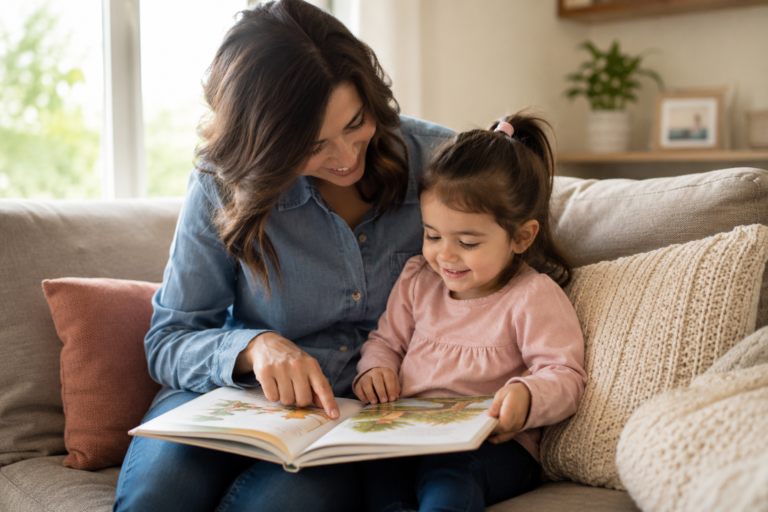
Instead of asking, “What is this?” on every page, try commenting first. You might say, “Big dog,” “The baby is sleeping,” “Uh-oh, it fell,” or “That bear looks happy.” If your child says one word, expand it naturally. If they say “dog,” you might say, “Brown dog,” or “Dog is running.”
Questions can still be part of book time, but they should not take over. A good balance is to make more comments than questions. This helps books feel like shared conversation instead of a test.
When to Get Support for Your Child’s Language Development
Trust Your Instincts Without Blaming Yourself
Getting help does not mean you have failed to do enough. Speech and language development is influenced by many factors, including hearing, understanding, motor planning, attention, social communication, temperament, and developmental differences. Parents do not cause a language delay by missing a few strategies.
A speech-language pathologist can help you understand your child’s communication profile and show you how to support language in a way that fits your daily life. The goal is not to pressure your child. The goal is to make communication easier, more successful, and more connected.
Signs It May Be Time to Ask for Guidance
- Your child is not using gestures like pointing, reaching, waving, or showing objects.
- Your child does not seem to understand simple directions during everyday routines.
- Your child is not using words or is using far fewer words than expected for their age.
- Your child is not combining words when other children their age typically are.
- Your child often becomes frustrated because they cannot communicate wants or needs.
- Your child has lost words or communication skills they used to have.
- Your child’s speech is very hard for familiar people to understand.
- You feel concerned, even if others are telling you to wait.
Support Can Be Gentle and Play-Based
A therapist may show you how to expand your child’s language, reduce pressure, create communication opportunities, and respond to your child’s attempts. These strategies can be woven into your real life, not added as another stressful task on your list.
The earlier you ask questions, the more options you have. Sometimes reassurance is enough. Other times, a plan can help your child make progress with less frustration and more confidence.
Frequently Asked Questions
How do I expand my child’s language without making them repeat me?
Your child does not need to repeat the phrase for it to count. Hearing the model in a meaningful moment is valuable. Over time, repeated models help children understand how words fit together.
Is it bad to ask my toddler questions?
A helpful approach is to use more comments than questions. Instead of asking, “What color is it?” you might say, “That’s a red truck.” This gives your child language they can learn from without pressure.
What should I say if my child only uses one word at a time?
This helps your child hear how single words can grow into combinations. You are showing the next step without expecting a perfect sentence right away.
Should I correct my child’s grammar or pronunciation?
This keeps the conversation positive. Constant correction can interrupt communication, while gentle modeling gives your child a better example without shame or pressure.
Can screen time help expand my child’s language?
If your child does watch a show, you can make it more interactive by watching together and commenting briefly. Still, everyday routines, play, books, and conversation are usually stronger language-building opportunities.
What if my child gets frustrated when I try language strategies?
Frustration can also be a sign that your child needs more support. A speech-language pathologist can help you understand what is hard for your child and show you strategies that match their current communication level.
Not Sure Where Your Child Falls?
Answer a few questions and we’ll tell you whether their development
looks on track — or whether it’s worth talking to an SLP.
A Few Final Thoughts on Helping Your Child Talk More Naturall
Expanding your child’s language without drilling is not about doing everything perfectly. It is about small, warm moments repeated often. A word added during snack, a phrase modeled during play, or a comment shared during a book can all help language grow.
Your child does not need to be quizzed all day to learn. They need connection, repetition, clear models, and chances to communicate for real reasons. When language feels useful and safe, many children become more willing to try.
It is also okay if progress feels uneven. Children often understand more before they can say more. They may use a word once and then not use it again for a while. That does not mean your effort is wasted.
For additional parent-friendly information about responsive language strategies, visit The Hanen Centre.
Keep talking with your child in ways that feel natural, responsive, and kind. If you are concerned about your child’s language development, reaching out for support can give you clarity and a plan that fits your child, your family, and your everyday life.
Image Placement: Place image at the end of the article or above the final call-to-action area.