
Autism Diagnosis and Speech Therapy: A Parent’s Guide to Next Steps
Getting an autism diagnosis for your child can bring many feelings at once. Some parents feel relief because they finally have words for what they have been noticing. Others feel worried, overwhelmed, or unsure where to begin. All of those reactions are understandable, especially when the next steps feel like a long list instead of a clear path.
Autism can affect communication in many different ways. Some autistic children use spoken words, some use gestures or sounds, some repeat phrases, some communicate with pictures or devices, and some use a mix of all of these. Speech therapy after an autism diagnosis is not about changing who your child is. It is about helping your child communicate more clearly, comfortably, and successfully in everyday life.
A good speech therapy plan looks at more than how many words a child says. It also considers understanding, play, social connection, gestures, sensory needs, attention, frustration, and the many small ways children show us what they want, feel, notice, and enjoy. The CDC notes that speech and language therapy can support both understanding and use of communication, including speech, gestures, pictures, signs, or electronic communication systems.
This guide will walk you through what speech therapy may look like after an autism diagnosis, what parents can ask during the first appointments, and how to support communication at home without pressure. The goal is to help you feel more grounded, more prepared, and more confident as you take the next step.
What Speech Therapy Can Help With After an Autism Diagnosis
Speech Therapy Supports Communication, Not Just Talking
Many parents hear “speech therapy” and think it only means helping a child say more words. Words can be part of therapy, but communication is much bigger than speech alone. A speech-language pathologist, often called a speech therapist, looks at how your child understands language, shares attention, makes choices, asks for help, protests, plays, connects, and uses any form of communication available to them.
For autistic children, communication may not always look the way parents expect. A child may lead you by the hand, bring you an object, repeat a favorite line from a show, use facial expressions, make sounds, reach, point, or move away when something feels like too much. These are all communication signals. Speech therapy helps families notice those signals and build on them in respectful, useful ways.
The purpose is not to force eye contact, demand repeated words, or make a child communicate in only one “typical” way. The purpose is to give the child more power to express needs, thoughts, feelings, interests, and choices. When communication becomes easier, daily routines often become less frustrating for both the child and the family.
Autistic Children May Need Different Communication Pathways
Speech therapy can help parents understand what their child’s communication style may mean. For example, a child who repeats “time to go” from a favorite video may be asking to leave, remembering a routine, or using a familiar phrase when they feel uncertain. A skilled therapist looks for the message underneath the words or actions instead of dismissing them as random behavior.
Children may also benefit from visual supports, signs, gestures, picture communication, or AAC. AAC stands for augmentative and alternative communication. ASHA describes AAC as a way to support communication through tools such as symbols, pictures, gestures, or devices, and it can be used alongside spoken language rather than replacing it.
Therapy Should Be Functional and Family-Centered
Family-centered speech therapy does not expect parents to become therapists all day long. Instead, it helps parents use small, realistic strategies during routines they are already doing. This might include waiting a little longer before helping, offering choices, modeling simple words, using pictures, or responding warmly when the child communicates in any way.
The best therapy plans respect the family’s daily life. A strategy that only works at a therapy table is not enough. Parents need support that fits their home, their child’s personality, their culture, their schedule, and their emotional bandwidth. When therapy feels doable, families are more likely to use the strategies consistently.

Autism Diagnosis and Speech Therapy: What Parents Can Expect
The First Sessions Usually Start With Understanding Your Child
The first speech therapy appointments are often about learning who your child is. The therapist may ask about your child’s communication, play, routines, favorite activities, sensory preferences, feeding history, hearing history, frustration patterns, and what your family wants help with most. This information matters because communication does not happen in isolation.
Your child may be observed during play, movement, snack, books, or simple back-and-forth interactions. A speech-language pathologist may look at how your child requests, responds, imitates, understands words, uses gestures, follows routines, notices people, and handles changes. For some children, formal testing is useful. For others, observation and caregiver interview provide a clearer picture.
Parents sometimes worry if their child does not “perform” during an evaluation. That is very common. A good therapist knows that one session does not show everything. Your observations as a parent are valuable because you see your child across many moods, settings, and routines.

Goals Should Match Your Child’s Real-Life Needs
For a young child, a strong goal might be using a word, sign, picture, or device button to ask for “more” during a favorite game. For another child, it might be learning to tell a parent “stop,” “help,” or “all done.” For a child with more spoken language, therapy may focus on conversation, flexible language, self-advocacy, understanding social situations, or telling personal stories.
Parents can ask how each goal will help at home, school, daycare, or in the community. That question keeps therapy practical. A goal should not only look good on paper. It should help your child be better understood and more connected in daily life.
Progress May Look Different Than Parents Expect
It is also common for skills to show up first in therapy and later at home, or first at home and later in therapy. Children may communicate more when they feel regulated, safe, interested, and understood. Stress, illness, sensory overload, sleep changes, and transitions can all affect communication on a given day.
Parents should not measure success only by word count. Spoken words matter, but so do connection, understanding, choices, emotional regulation, and the ability to repair communication when something goes wrong. Speech therapy is most helpful when it values the whole child, not just the sounds coming out of the child’s mouth.
How Parents Can Support Communication at Home
Follow Your Child’s Interests Before Adding Language
Instead of trying to pull your child away from what they love, join them gently. Sit nearby, copy the play, comment on what is happening, and wait for small moments of connection. A parent might say “spin,” “fast car,” “open,” or “you found blue” without requiring the child to repeat anything. This kind of modeling gives language without pressure.
Children often communicate more when adults stop turning every moment into a test. Questions like “What’s this?” and “Say car” can feel demanding, especially for children who are still building communication. Simple comments, playful sounds, and warm responses often work better because they make language feel useful and connected.
Use Short, Clear Language During Everyday Routines
Parents can use short phrases that match the moment. During snack, you might say “open,” “more cracker,” “all done,” or “want juice.” During play, you might say “go car,” “big jump,” “fall down,” or “my turn.” The goal is not to narrate nonstop. The goal is to give your child simple language that connects directly to what they are seeing, feeling, and doing.
It also helps to pause. Many children need extra time to process language and plan a response. A pause gives your child room to look, gesture, reach, vocalize, use a picture, or try a word. Waiting can feel quiet at first, but it often creates more communication than rushing in too quickly.
Respect All Forms of Communication
Respecting all communication does not mean giving in to every request. It means acknowledging the message. A parent might say, “You want the phone. I hear you. Phone is all done,” while offering another choice. This helps the child feel understood, even when the answer is no.
For some children, AAC can reduce frustration and give them a more reliable way to communicate. It is a common myth that AAC stops speech from developing. In practice, AAC is often used to support communication while speech and language continue to grow. Children deserve access to communication now, not only after they prove they can talk.
When to Seek Help or More Support After an Autism Diagnosis
It Is Okay to Ask for Guidance Early
Seeking help does not mean something is “wrong” with your child. It means your child may benefit from support that matches how they learn and communicate. Many autistic children thrive when adults understand their communication style and provide tools that make expression easier.
Parents should also know that support can include more than one professional. Depending on the child’s needs, the team may include a speech-language pathologist, occupational therapist, developmental pediatrician, psychologist, early intervention provider, teacher, or feeding therapist. A team approach can help families see the whole child more clearly.
Signs Your Child May Benefit From Speech Therapy Support
- Your child is not using words, gestures, sounds, signs, pictures, or AAC to communicate basic needs.
- Your child seems frustrated because others do not understand what they want.
- Your child rarely responds to their name or familiar language, even when hearing has been checked.
- Your child has trouble following simple daily directions.
- Your child uses words but has difficulty using them flexibly in real situations.
- Your child repeats phrases but seems unsure how to use language to ask, answer, or share ideas.
- Your child has limited play skills or has trouble joining back-and-forth interaction.
- Your child communicates mostly by pulling adults, crying, or melting down because other tools are not working yet.
- Your child may need visual supports, signs, or AAC to communicate more successfully.
What Parents Can Ask the Speech Therapist
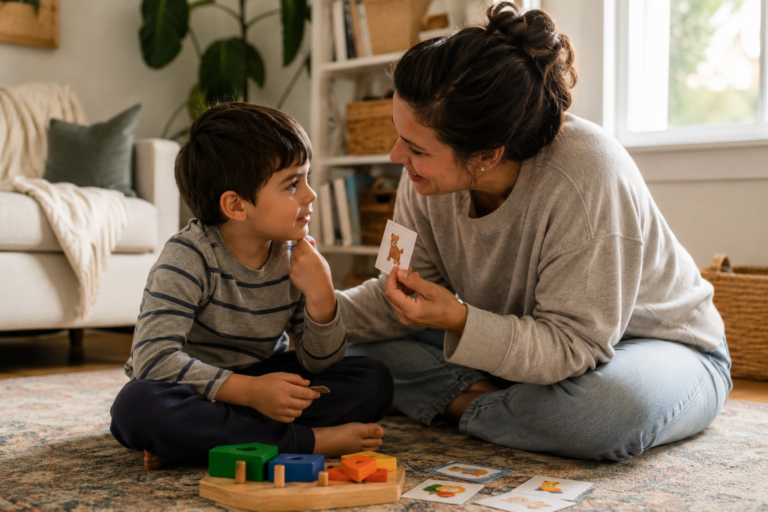
You can also ask how progress will be measured. Progress may include more words, but it may also include fewer communication breakdowns, more gestures, better understanding, more shared play, stronger self-advocacy, or more successful use of pictures or devices. Clear expectations help parents feel less lost.
Most importantly, look for a therapist who respects your child. Therapy should feel supportive, not forceful. Your child may be challenged, but they should also feel safe, seen, and allowed to communicate in ways that are meaningful for them.
FAQ: Autism Diagnosis and Speech Therapy
Does every autistic child need speech therapy?
The need depends on the child’s strengths and challenges. Some children need intensive support, while others need targeted help with conversation, flexible language, or communication in school and social settings.
Will speech therapy make my autistic child talk?
Parents should be cautious of anyone who promises speech by a certain date. Children develop differently, and therapy should focus on helping the child communicate more successfully now while continuing to support long-term growth.
Is AAC only for children who will never talk?
AAC can reduce pressure and give a child another way to communicate when speech is hard. Many children use AAC together with spoken language, gestures, sounds, and facial expressions.
What should I do while waiting for speech therapy?
You can also write down examples of how your child communicates at home. Bring notes about favorite activities, frustration triggers, words or sounds used, gestures, and routines that are hard. This helps the speech therapist understand your child more quickly.
Should speech therapy focus on eye contact?
A more helpful focus is shared attention and meaningful interaction. That may look like looking at an object together, taking turns in play, responding to a sound, exchanging a picture, or sharing enjoyment in a way that feels comfortable for the child.
How soon should speech therapy start after an autism diagnosis?
Early support can help parents understand what their child is communicating and how to build useful skills during everyday routines. For children under age 3, early intervention programs are often an important place to start.
Not Sure Where Your Child Falls?
Answer a few questions and we’ll tell you whether their development
looks on track — or whether it’s worth talking to an SLP.
A Few Final Thoughts on Autism Diagnosis and Speech Therapy
Speech therapy after an autism diagnosis should help your child communicate with more confidence and less frustration. That may include words, gestures, signs, pictures, AAC, play, shared routines, or self-advocacy. The right path depends on your child’s needs, not on someone else’s timeline.
Parents do not have to figure everything out at once. Start with communication that matters in daily life. Help your child ask, refuse, choose, connect, and be understood. Those everyday moments are often where the most meaningful progress begins.
With supportive therapy, realistic expectations, and a communication approach that respects your child, the next step can feel less overwhelming. You are not behind, and you are not alone. One thoughtful step at a time is enough.
Want to learn more? The American Speech-Language-Hearing Association (ASHA) provides information about autism spectrum disorder, communication development, and how speech-language pathologists support children and families after an autism diagnosis.