
What Is Parallel Talk — and Why SLPs Use It Constantly
For toddlers and late talkers, language often develops best during shared experiences that feel natural and pressure-free. That is one reason SLPs rely on parallel talk so often during therapy sessions. A child stacking blocks might hear, “Up, up, up… big tower,” while a toddler splashing in the bath may hear, “Splashing water… kick kick kick.” These simple phrases help connect words to real experiences in a way that feels meaningful and easy to process.
Many parents are already doing pieces of parallel talk without realizing it. The difference is usually consistency and pacing. Speech therapists intentionally slow language down, follow the child’s focus, and model words that match the moment. Instead of testing children with constant prompts like “What’s this?” or “Say ball,” parallel talk creates a more relaxed communication environment where language can grow naturally over time.
The strategy is especially helpful because it works almost anywhere. SLPs use parallel talk during play, meals, walks, diaper changes, book reading, and everyday routines. Once parents understand how it works, they often realize they do not need special toys, flashcards, or long practice sessions to support communication. Small moments throughout the day can become powerful opportunities for language learning.
Why Parallel Talk Helps Children Learn Language
Parallel Talk Connects Words to Real Experiences
Children learn language best when words are connected to something meaningful they are actively experiencing. Parallel talk works because it pairs language with actions, objects, movement, emotions, and sensory experiences happening in real time. Instead of hearing isolated vocabulary words, children hear language attached to moments their brains are already paying attention to.<br><br>
For many toddlers, especially children with delayed expressive language, understanding language develops before spoken words do. Parallel talk supports this understanding by giving repeated exposure to simple vocabulary in predictable situations. Over time, children begin recognizing patterns between words and experiences, which helps build comprehension and eventually spoken language.<br><br>
Speech therapists often describe this as “mapping language onto experience.” A child pushing a toy car hears “go car,” “fast car,” or “car driving.” The child does not need to repeat the words immediately for learning to happen. Hearing language consistently during meaningful activities is already building important communication foundations.
It Reduces Pressure During Communication
This calmer communication style can be especially helpful for late talkers, highly sensitive children, or toddlers who become overwhelmed during direct prompting. Many children communicate more freely when they feel emotionally safe and not constantly expected to “perform” language on command.
SLPs often balance questions with far more comments and observations during therapy sessions. That balance helps create conversational interaction without turning communication into a quiz. Parallel talk keeps interaction flowing while still exposing children to rich language models throughout the day.
It Encourages Joint Attention and Engagement
When an adult follows a child’s interests instead of redirecting constantly, children are often more engaged and attentive. A toddler who is deeply interested in pouring water, spinning wheels, or lining up toys is more likely to notice language connected to those activities because the experience already matters to them.
This is one reason speech therapists frequently “follow the child’s lead” during sessions. Parallel talk fits naturally into child-led interaction because the adult stays connected to what the child is already exploring instead of trying to control every moment of play.
What Parallel Talk Actually Sounds Like
Parallel Talk During Everyday Play
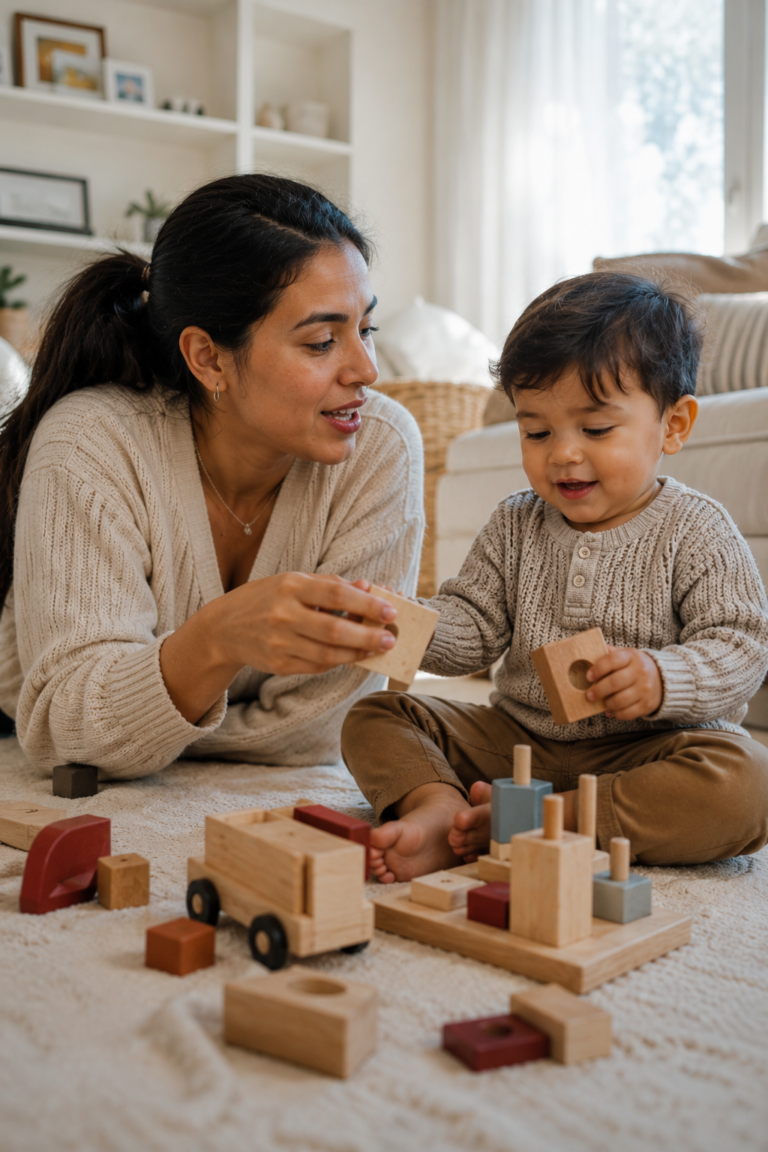
For example, if a toddler is building with blocks, an adult might say, “Big tower,” “Uh oh, it fell,” or “Stacking blocks.” During pretend play, phrases like “Baby sleeping,” “Bear eating,” or “Driving fast” naturally expose children to vocabulary and early sentence structure.
Speech therapists often keep phrases slightly above the child’s current language level. A child using single words may benefit from hearing short two-word combinations, while a child using phrases may benefit from hearing slightly longer models connected to play.
Parallel Talk During Routines
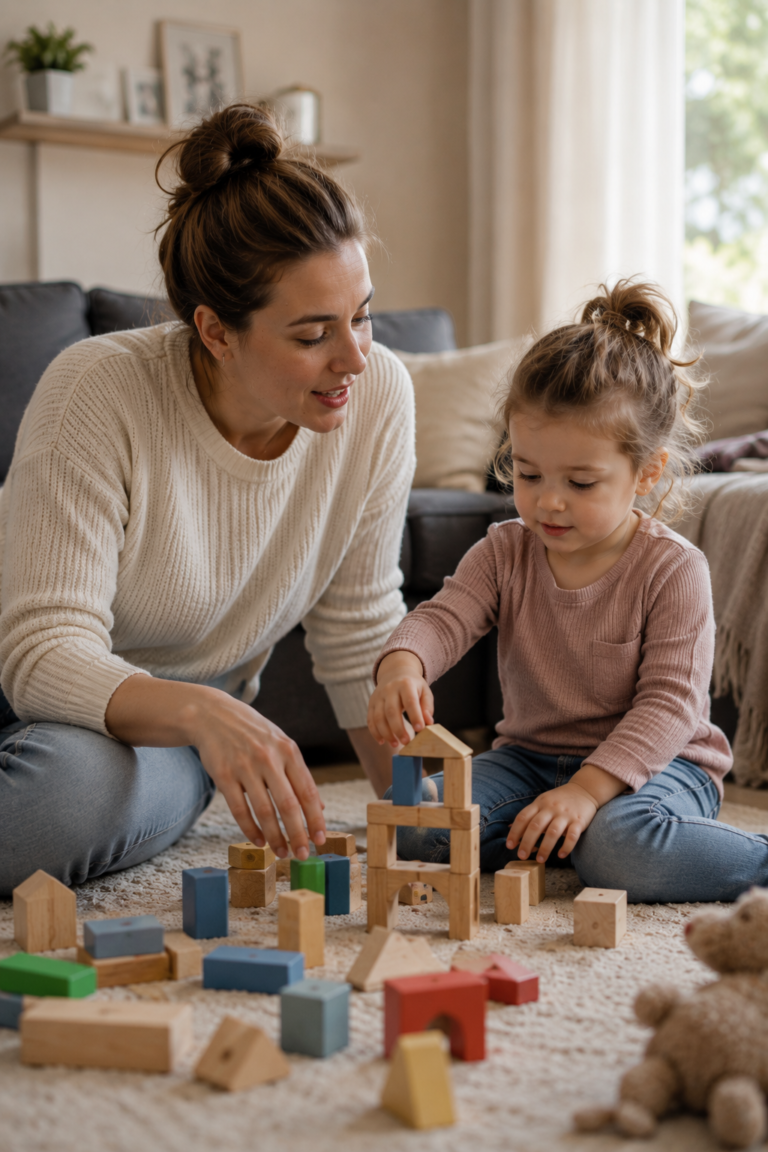
During snack time, an adult might say, “Pour juice,” “Crunchy cracker,” or “More banana.” During bedtime routines, phrases like “Soft blanket,” “Turn off light,” or “Teddy sleeping” help children hear functional language connected to familiar experiences.
These moments do not need to feel scripted or formal. In fact, parallel talk often works best when it sounds conversational and relaxed. The goal is simply to increase meaningful language exposure throughout normal family routines.
Parallel Talk Is Different From Constant Talking
Children need time to process language, observe interaction, and sometimes respond nonverbally. A slower pace often supports language learning more effectively than rapid adult speech. Short comments paired with pauses give children opportunities to absorb what they hear.
Many SLPs intentionally simplify their language while using expressive tone, facial expressions, and gestures. Communication is not only about words themselves but also about emotional connection, shared attention, and interaction quality.
Why Speech Therapists Use Parallel Talk So Frequently
It Fits Naturally Into Child-Led Therapy
Modern pediatric speech therapy often focuses heavily on interaction-based learning. Instead of sitting children at a table drilling flashcards, many therapists use play, routines, movement, and shared experiences to build communication. Parallel talk fits perfectly into this style of therapy because it supports language without interrupting engagement.
When children are emotionally regulated and actively interested in an activity, they are often more available for learning. Parallel talk allows therapists to support language while preserving the child’s attention and motivation. This approach can feel much more natural for toddlers than highly structured teaching methods.
Parents are sometimes surprised by how conversational speech therapy sessions look. A large part of effective early language intervention involves responsive interaction rather than constant correction or direct instruction.
Parallel talk works especially well when combined with modeling instead of repeated prompting. Learn more in Modeling vs. Prompting — What Works Better at Home.
It Supports Many Different Communication Goals
Because the strategy adapts easily, it can work for children at many developmental levels. Some children may simply benefit from hearing repeated single words connected to actions, while others may hear more advanced sentence structures modeled naturally throughout play.
SLPs also frequently combine parallel talk with gestures, signs, visual supports, and pauses that encourage interaction. Communication development is rarely about one isolated technique. Instead, therapists layer supportive strategies together throughout meaningful activities.
Parents Can Learn It Quickly
One reason speech therapists teach parents parallel talk so often is because it is practical and realistic for daily life. Families do not need complicated materials or lengthy practice sessions to begin using it at home. The strategy fits naturally into activities families are already doing every day.
Many parents notice that communication starts feeling less stressful once they shift away from constant quizzing or prompting. Following a child’s interests and describing experiences often creates more enjoyable interaction for both the child and the adult.
Over time, small language moments add up. A few simple comments during play, meals, bath time, or outdoor walks can provide hundreds of meaningful opportunities for language exposure throughout a normal week.
Parallel talk is one of several natural ways to encourage language. You can find more practical examples in How to Expand Your Child’s Language Without Drilling.
When to Seek Help or Extra Support
When Language Development Feels Unclear
If a child rarely attempts interaction, struggles to understand simple language, loses communication skills, or becomes extremely frustrated during communication attempts, it may be helpful to seek guidance from a speech-language pathologist. Early support does not automatically mean something is seriously wrong. Often, families simply benefit from strategies tailored to their child’s communication style.
Many children benefit from early language support even when development later catches up naturally. Getting questions answered early can reduce uncertainty and help parents feel more confident supporting communication at home.
Signs It May Help to Talk With an SLP
- Limited babbling, gestures, or spoken words compared to expected developmental patterns
- Difficulty understanding simple directions or everyday language
- Frustration during communication attempts
- Limited eye contact, shared attention, or interaction during play
- A noticeable loss of previously used words or social communication skills
- Concerns from caregivers, pediatricians, or childcare providers about communication development
Early Support Can Be Reassuring
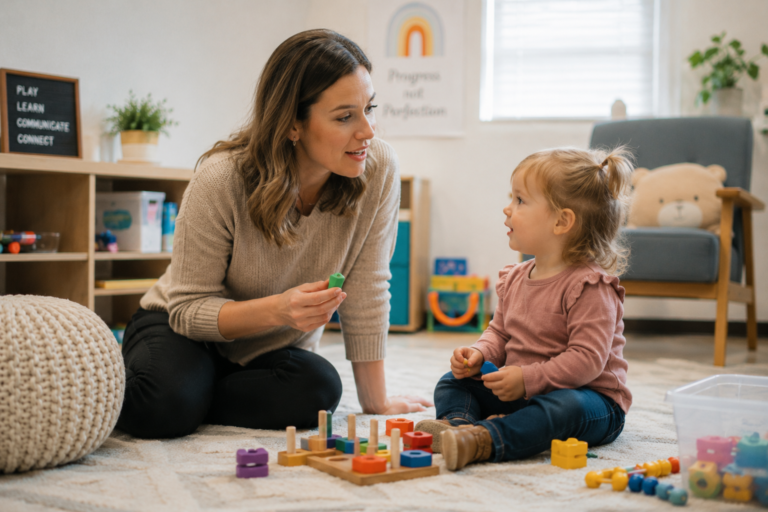
Speech therapists look at the whole communication picture, including play skills, understanding, interaction style, gestures, attention, and social engagement. Spoken words are only one part of early communication development.
Parents do not need to have all the answers before reaching out for support. Sometimes a conversation with a professional simply helps families better understand what communication development can realistically look like during the toddler years.
Frequently Asked Questions About Parallel Talk
Is parallel talk the same as self-talk?
Speech therapists often combine the two naturally during interaction. Together, they increase language exposure in a way that feels conversational and easy for young children to process.
Does parallel talk help late talkers?
It is important to remember that children do not need to repeat words immediately for learning to happen. Consistent exposure, shared interaction, and emotional connection all play important roles in communication development.
Should I use full sentences during parallel talk?
As children’s language skills grow, adults can gradually model longer and more complex phrases. The goal is to stay just slightly above the child’s current communication level.
Can I use parallel talk all day?
Pauses are important too. Children need time to observe, process language, and participate in interaction in their own way, whether through gestures, sounds, facial expressions, or words.
Why do speech therapists avoid asking too many questions?
Speech therapists usually balance questions with many more comments, observations, and playful interaction. This often creates a calmer communication environment that encourages participation more naturally.
Can parallel talk help children who are not talking yet?
Hearing simple language connected to meaningful experiences helps build foundational understanding that supports later communication growth. Many pre-verbal children benefit from rich, responsive interaction even before spoken language emerges.
Not Sure Where Your Child Falls?
Answer a few questions and we’ll tell you whether their development
looks on track — or whether it’s worth talking to an SLP.
A Few Final Thoughts on Parallel Talk in Speech Therapy
Parallel talk is one of those speech therapy strategies that sounds simple because it truly is simple. At its core, it is just responsive, connected communication built around a child’s experiences and interests. Yet this small shift in interaction style can make a meaningful difference in how children experience language throughout the day.
Speech therapists use parallel talk constantly because it supports learning in a natural, low-pressure way. Instead of turning communication into drills or quizzes, it helps children connect words to real life through play, routines, movement, and shared attention.
For many families, learning to use parallel talk also changes the emotional tone around communication. Parents often feel less pressure to “get their child to talk” and more confidence in simply connecting, observing, and interacting throughout everyday moments.
For more parent-friendly information about responsive communication strategies, visit The Hanen Centre.
Language development happens gradually, through thousands of small interactions over time. Parallel talk reminds us that meaningful communication support does not always require complicated tools or perfect teaching moments. Often, the most powerful language learning happens during ordinary moments shared together.