
What Are You Noticing About Your Child's Speech?

Real answers to specific concerns — late talking, unclear speech, stuttering, and more — written by a certified speech-language pathologist.
Parent sitting on floor with toddler, looking attentive and calm — recognizing early signs of speech delay
Something caught your attention — a word that still hasn’t come, a sound that doesn’t quite land right, a stutter that started last week. Whatever brought you here, you’re paying attention to something important.

Speech and language concerns are among the most common worries parents bring to their pediatrician — and to us. The challenge is that development varies enormously from child to child. Knowing the difference between a child who’s taking their time and one who genuinely needs support isn’t always obvious from a checklist.

This section of SpeechTherapy.org is organized around the specific things parents actually notice: a toddler who isn’t talking yet, speech that’s hard to understand, words that stopped coming, or a stutter that seems to be getting worse. Each page goes deeper than a milestone chart — it tells you what that particular sign usually means, what the range of normal looks like, and when it’s worth calling an SLP.

Everything here is written by John Burke, a certified speech-language pathologist with over a decade of experience working with young children and their families. No unnecessary alarm, no vague reassurances — just clear, honest answers you can use.

Browse by What You're Seeing

Choose the area that best matches your concern — each section goes deeper with specific articles below.
late talking toddler parent watching

Late Talking

A late talker is a young child who has fewer words than expected for their age — but whose understanding, play, and social skills are developing typically. It’s one of the most common concerns parents bring to a speech therapist, and one of the most nuanced to sort out. These five articles cover the full picture.

  • What is a late talker?
  • Late talker vs. speech delay — what’s the difference?
  • Late talker vs. autism — how to tell
  • Will my child just catch up on their own?
  • My toddler understands everything but won’t talk
Parent leaning in to listen to toddler speaking — unclear speech and articulation in young children

Speech Clarity

Unclear speech in toddlers is extremely common — and expected at certain ages. But there’s a meaningful difference between typical articulation errors and a pattern that needs support. These articles walk through what parents are most often seeing, and what it usually means.

  • My toddler’s speech is hard to understand
  • What is an articulation disorder?
  • What is a lisp — and does it need treatment?
  • My child drops the ends of words
  • When should strangers be able to understand my child?
toddler gesturing language fluency delay

Language & Fluency

Language delays look different from speech sound problems — and they’re easy to miss when a child seems to understand everything being said to them. Fluency issues like stuttering add another layer of worry for parents. These six articles cover the questions we hear most often in this area.
  • My child has words but isn’t putting them together
  • What is an expressive language delay?
  • What is a receptive language delay?
  • My child stopped talking — speech regression in toddlers
  • My toddler is stuttering — is this normal?
  • When does normal disfluency become a stutter?
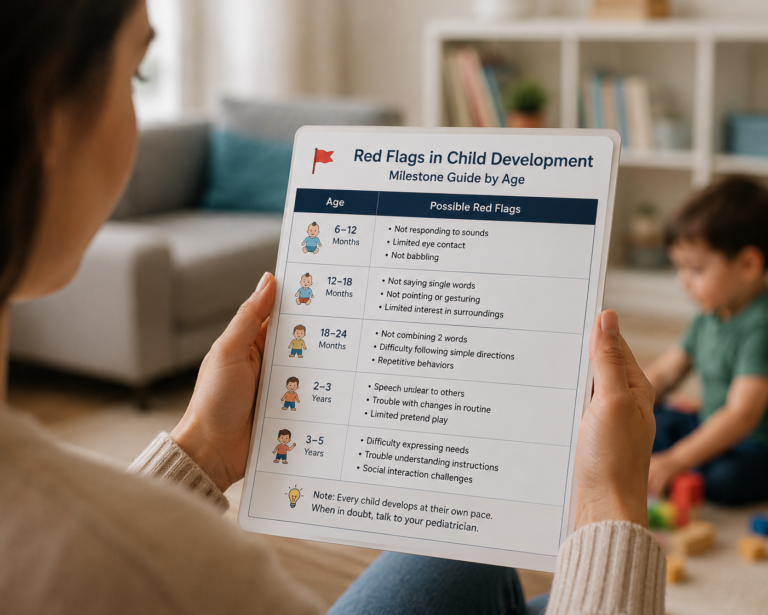
Parent reviewing speech and language red flags by age — when to be concerned about a toddler's development

Red Flags

Most speech differences in young children fall within the wide range of typical development. But some signs — particularly when they cluster together, appear suddenly, or persist past expected age ranges — deserve prompt attention. These four articles help you identify the difference.

  • Speech and language red flags by age
  • When to call your pediatrician about speech
  • Signs that point toward autism vs. a speech delay

Not Sure Where Your Child Falls?

Our free speech screener takes less than 3 minutes.
Answer a few questions and we’ll tell you whether their development
looks on track — or whether it’s worth talking to an SLP.
No sign-up required. Takes about 3 minutes.

Frequently Asked Questions

What are the first signs of a speech delay in a toddler?
The earliest indicators are usually not about words — they’re about communication. A baby who isn’t babbling by 9–10 months, not gesturing (waving, pointing) by 12 months, or not using any words by 16 months warrants attention. In toddlers, having fewer than 50 words by age 2 or not combining words is a common first signal. The important thing to watch is the pattern, not just a single milestone.
This is actually a very common presentation — and it doesn’t automatically mean something is wrong. Some children are stronger receptive language developers and catch up expressively on their own. That said, at age 2, a child should have at least 50 words and be starting to combine them. If they’re significantly below that, it’s worth an evaluation even if comprehension looks strong.
Many toddlers between ages 2 and 4 go through a period of normal disfluency — repeating syllables, getting stuck on words, revising sentences mid-stream. This is a typical part of language development as their ideas outpace their speech. It becomes more concerning when stuttering persists past age 5, worsens over time, or is accompanied by visible physical tension or your child’s avoidance of speaking.
A speech delay and autism can overlap — but they’re not the same thing. Many children with speech delays don’t have autism, and not all autistic children have speech delays. The key differences tend to show up in social engagement: does your child make eye contact, respond to their name, point to share interest, and engage in back-and-forth play? Speech delays typically don’t affect these social behaviors the way autism does.
A general clinical guideline: at age 2, parents understand about 50% of their child’s speech; at age 3, familiar adults understand about 75%; by age 4, strangers should understand the majority of what a child says. If your child is significantly below these benchmarks, an articulation or phonological evaluation is a reasonable next step.
A sudden loss of previously acquired language — called speech regression — always deserves attention. In toddlers, it can sometimes follow a major life change or illness and resolve on its own. But regression that persists beyond a few weeks, especially when accompanied by changes in social engagement or play, should be evaluated promptly by both your pediatrician and a speech-language pathologist.
Not always, and not immediately. The “s” sound — where most lisps occur — typically isn’t fully established until age 4–5. A frontal lisp (tongue between teeth on “s” sounds) often resolves on its own. A lateral lisp (air flowing over the sides of the tongue) is less likely to self-correct and usually benefits from therapy. If your child’s lisp is affecting intelligibility or confidence, an SLP evaluation is a reasonable step regardless of age.

Explore More on SpeechTherapy.org

What you’re seeing and what it might mean. Specific answers for specific behaviors.
Evaluations, finding an SLP, early intervention, insurance, and cost — all in one place.
Games, strategies, and everyday routines that build language in the small moments.
Scroll to Top