
Is My Child on Track? Speech & Language Development, Ages 0–5

Age-by-age milestones, real answers to your biggest questions, and guidance from a certified speech-language pathologist.
Parent kneeling at toddler eye level, smiling and talking during early speech development at home
If you’ve found yourself Googling “when should my child say their first word” at midnight, you’re not alone — and you’re in exactly the right place.

Every parent wonders whether their child is developing on track. Speech and language development in the early years is one of the most common concerns we hear — and one of the most important to understand. The good news? Knowing what to look for makes all the difference.

This section of SpeechTherapy.org walks you through what healthy communication looks like from birth to age five — clear, age-by-age milestones, honest answers to the questions parents actually ask, and guidance on when it might be time to take the next step.

Everything here is written by John Burke, a certified speech-language pathologist with over a decade of experience working with young children. No alarm bells, no jargon — just real information you can use today.

Milestones by Age: Birth to 5 Years

Wondering if your child is on track? Start with your child’s age.
Newborn making eye contact with parent — early communication development

Birth to 6 Months

Coos, startles to sounds, recognizes your voice. What communication looks like before words.

Baby babbling in high chair — 6 to 12 month speech milestones

6 to 12 Months

Babbling begins. Gestures like waving. Understanding "no" and their own name.

Toddler pointing and saying first words at 12 to 18 months

12 to 18 Months

First real words. Usually 1–3 by 12 months, 10–20 by 18 months. Points to communicate.

Toddler using two-word phrases during play — 18 to 24 month language development

18 to 24 Months

The two-word stage. "More milk." "Daddy go." Vocabulary explodes — 50+ words by age 2.

Two year old having a conversation with parent — language development ages 2 to 3

2 to 3 Years

Three-word sentences. Strangers understand ~50–75% of speech. Questions and stories begin.
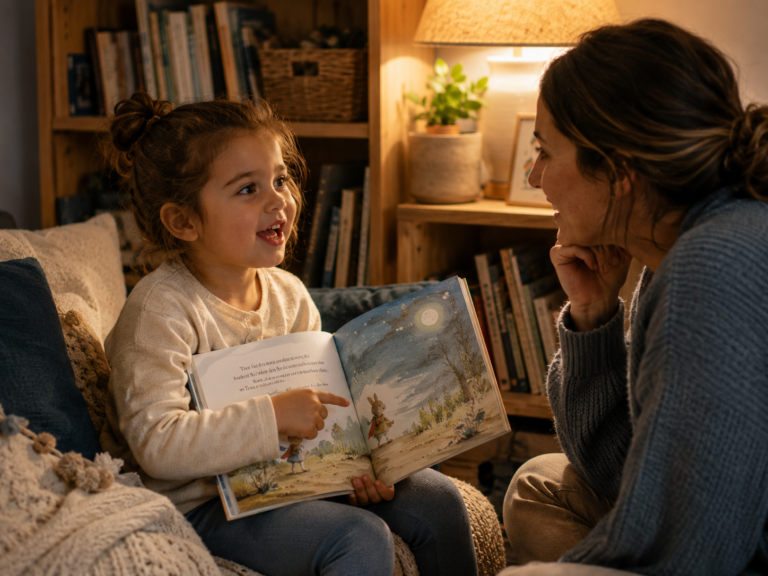
Preschool child storytelling with parent — speech development ages 3 to 5

3 to 5 Years

Full conversations. Storytelling. School-readiness. Strangers understand almost everything.

How Many Words Should My Child Have?

One of the most Googled questions about toddler development. Word count is one of the clearest early indicators of language growth.
Here’s a straightforward breakdown:
  • 12 months — 1–3 words beyond “mama” and “dada”
  • 15 months — 5–10 words
  • 18 months — 10–20+ words
  • 24 months — 50+ words, beginning two-word combinations
  • 3 years — 200–1,000 words, three-word sentences
  • 4–5 years — 1,000–2,000+ words, full conversations
Keep in mind: vocabulary count alone isn’t the full picture. How your child uses words — to communicate wants, comment on the world, and connect with you — matters just as much as the number.

→ Full guide: How Many Words Should My Child Have at Each Age?

Speech-language pathologist showing vocabulary picture cards to a toddler during speech therapy

What Sounds Should My Child Be Making — and When?

Not all speech sounds develop at the same time — and that’s completely normal. Children master sounds in a predictable sequence.

Here’s a simplified guide:

By Age 2
p, b, m, h, w, and n sounds. These are early sounds — easy to see on the mouth and produced naturally in babbling.
k, g, f, t, d, and ng sounds are added. Some errors on harder sounds are still completely normal at this stage.
l, sh, ch, j, s, and z sounds develop. Many children are still refining s and r through early elementary school — this is typical.
r, th, and blends like “str” and “spl” are fully established. Errors before age 7 on these sounds are expected and normal.
A speech sound error only becomes a clinical concern when it persists beyond the expected age range. An SLP can assess exactly which sounds your child uses — and whether therapy is appropriate.

→ Full chart: What Sounds Should My Child Be Making?

"Is This Normal?" — Common Parent Concerns

You’ve noticed something — a missing word, a sound that doesn’t seem right, a sudden silence. These pages are written for exactly that moment: clear, specific answers from an SLP, not a generic checklist.

Not Sure Where Your Child Falls?

Our free speech screener takes less than 3 minutes.
Answer a few questions and we’ll tell you whether their development
looks on track — or whether it’s worth talking to an SLP.
No sign-up required. Takes about 3 minutes.

Frequently Asked Questions

How do I know if my child has a speech delay or is just a late bloomer?
This is one of the hardest calls to make on your own — which is exactly why a speech-language pathologist evaluation is so valuable. A true “late bloomer” typically has strong comprehension and social engagement but is slower to produce words. A speech delay usually involves gaps in multiple areas. Our free screener is a useful starting point, but a professional assessment is the only way to know for certain.
Research links excessive passive screen time — especially before age 2 — to slower language development. The mechanism isn’t the screen itself, but the interaction time it replaces: face-to-face conversation, responsive play, and shared reading. Limited, co-viewed, interactive use is far less concerning than hours of solo passive viewing.
It depends on age. At 2 years, parents understanding about 50% of a child’s speech is typical. By age 3, most of what your child says should be clear to you. By age 4, strangers should understand the majority. If clarity is significantly behind these benchmarks, it’s worth scheduling an evaluation with an SLP.
Sometimes waiting is reasonable — language develops in spurts. But if you have a persistent concern, you don’t need a referral to see a private SLP. For children under 3, early intervention through your state is free and doesn’t require a physician referral. Trust your instincts as a parent.
No — bilingual children are not at higher risk for speech delays. They spread their vocabulary across two languages, so a word count in one language may look lower than monolingual peers. Total vocabulary across both languages is typically comparable. If you have concerns, seek an SLP experienced in bilingual development.

Explore More on SpeechTherapy.org

What you’re seeing and what it might mean. Specific answers for specific behaviors.
Evaluations, finding an SLP, early intervention, insurance, and cost — all in one place.
Games, strategies, and everyday routines that build language in the small moments.
Scroll to Top