
3 to 5 Year Old Speech Development: Conversations, Stories, and School Readiness
Between 3 and 5 years old, speech and language often begin to feel much more grown up. Your child may be telling you long stories, asking endless questions, negotiating bedtime, explaining what happened at preschool, or proudly using new words in surprising ways.
This stage of 3 to 5 year old speech development is about more than clear talking. Children are learning how to hold conversations, describe ideas, listen to stories, retell events, follow directions, play with sounds, and use language to connect with other people.
There is still a wide range of typical development during the preschool years. Some children are chatty and dramatic storytellers, while others need more time to organize their thoughts or feel confident speaking in groups. The goal is not perfection, but steady growth in communication.
In this guide, we’ll look at conversations, storytelling, speech clarity, and school readiness skills in a calm and practical way so you can better understand what to expect and when extra support may be helpful
How 3 to 5 Year Old Speech Development Supports Conversation
Back-and-Forth Talking Becomes More Natural
As children move toward 4 and 5, conversations usually become longer and easier to follow. They may stay on topic for more turns, respond to what someone else said, and add new information instead of only answering with one word.
These conversational skills matter because they help children build friendships, participate in preschool routines, and feel understood. Everyday talk during meals, play, errands, and bedtime gives children meaningful practice without needing formal lessons
Questions Become a Big Part of Learning
At this age, children also begin answering more complex questions. Instead of only naming objects, they may explain what happened, why someone is sad, where something belongs, or what might happen next in a story.
When a child struggles with questions, it does not always mean they are not listening. Sometimes they need more processing time, simpler wording, visual support, or help understanding the difference between question types.
Grammar Grows Through Everyday Speech
It is typical for preschoolers to say things like “I goed,” “her did it,” or “I runned fast.” These errors often show that children are learning language patterns and trying to apply rules, even when the rule does not quite fit.
Parents can support grammar gently by repeating the sentence back correctly. If your child says, “He goed home,” you might say, “Yes, he went home after school.” This gives a clear model without turning the moment into a correction.
Storytelling Skills During the Preschool Years
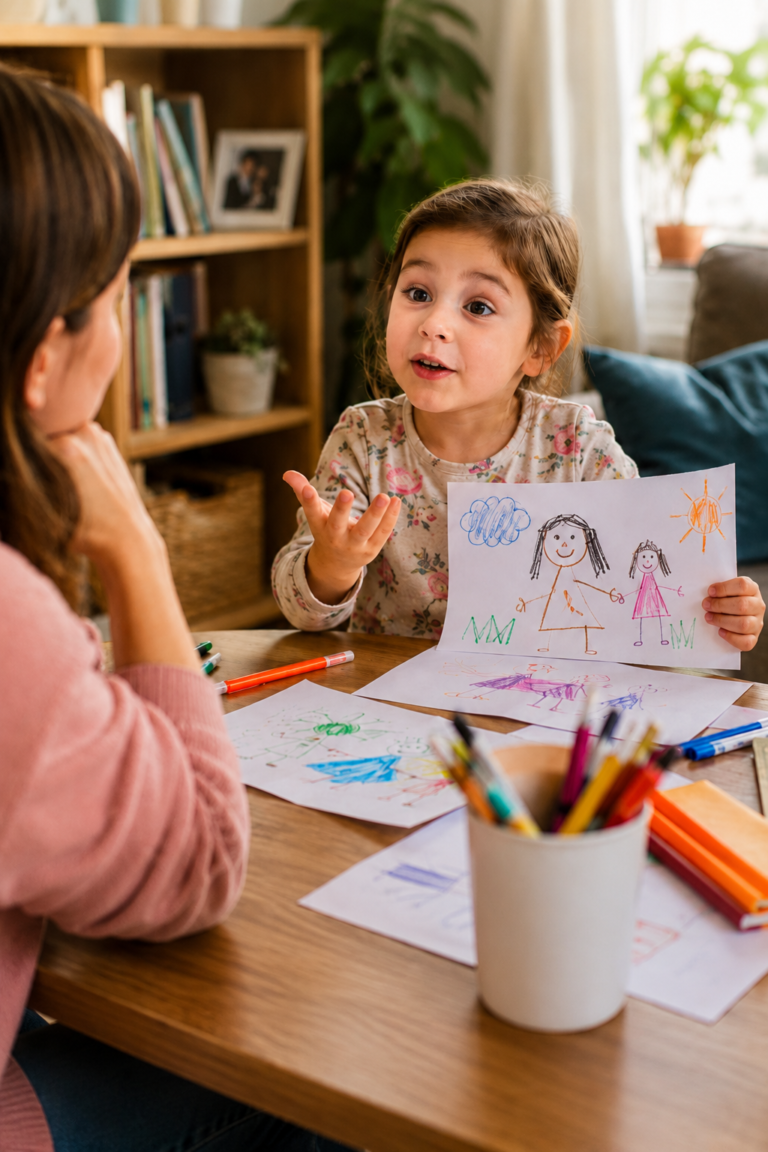
Children Start Retelling Real Events
This growth is important because storytelling helps children organize thoughts, sequence events, use memory, and connect ideas. These are the same skills children later use for reading comprehension and writing.
If your child’s stories are hard to follow, try asking gentle prompts like, “Who was there?” or “What happened next?” The goal is to help them build a story, not pressure them to tell it perfectly.
Pretend Play Builds Narrative Language
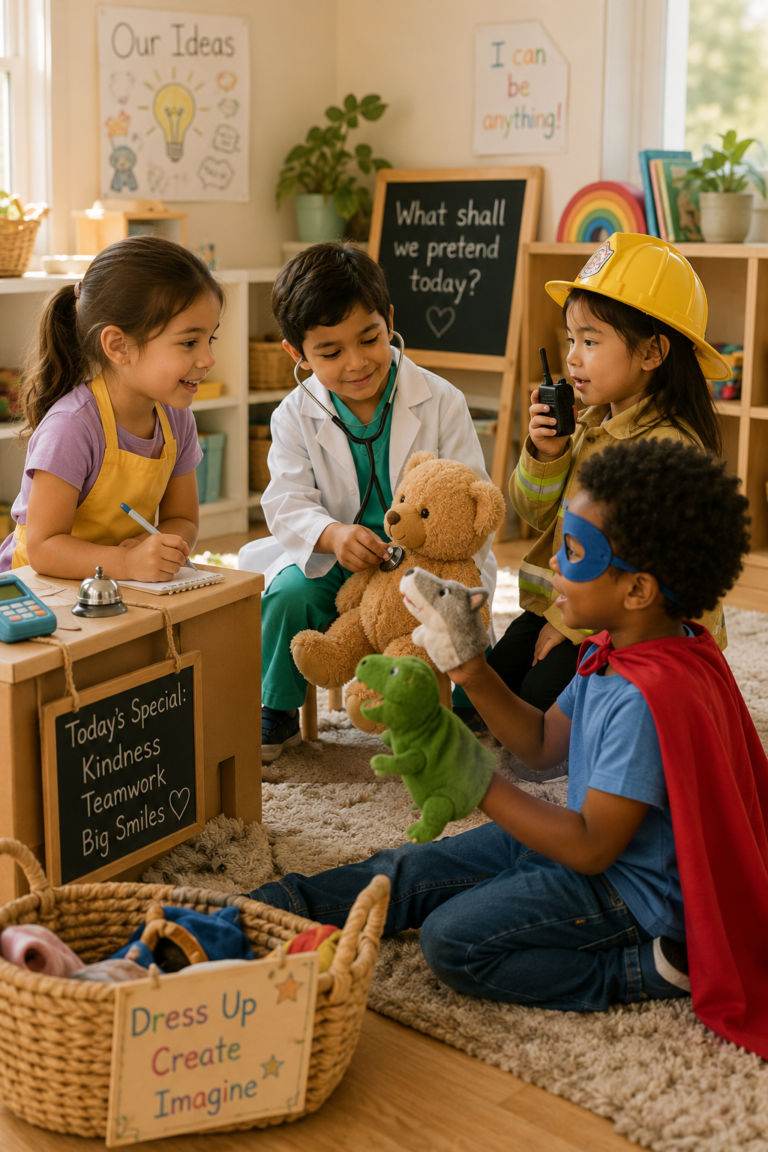
During pretend play, children often use longer sentences and more flexible language than they use in direct questioning. They may speak for characters, describe imaginary events, or change their voice to match a role.
Joining your child’s play can support language beautifully. Instead of directing the play, try adding small story pieces such as, “Oh no, the puppy is lost,” or “The doctor needs to find out what happened.”
Books Help Children Understand Story Structure
You do not need to read every book straight through. Pausing to wonder aloud, talk about pictures, predict what will happen, or connect the story to your child’s life can make reading more interactive.
For children who have trouble sitting for books, shorter reading moments still count. A few meaningful minutes with conversation can be more helpful than pushing through a long book when your child is tired or overwhelmed.
School Readiness Communication Skills From 3 to 5 Years
Following Directions Becomes More Important
Preschool and kindergarten routines ask children to listen, remember, and act on spoken directions. A child may need to hang up a backpack, sit on the rug, wash hands, line up, or choose an activity based on what an adult says.
Between 3 and 5, children usually become better at following longer and more specific directions. They may understand location words, sequence words, object functions, categories, and classroom language.
At home, simple routines can build this skill naturally. Directions like “Put your shoes by the door and bring me your jacket” help children practice listening, memory, and independence in a real-life way
If you’re wondering how understandable your preschooler should be at different ages, read When Should Strangers Be Able to Understand My Child?
Speech Clarity Supports Confidence
A child does not need every sound to be perfect before school. However, speech should be clear enough that they can express needs, join play, answer questions, and be understood without constant frustration.
If your child avoids talking, becomes upset when misunderstood, or is very difficult for others to understand, a speech-language evaluation can help identify whether support would make communication easier.
Early Literacy Starts Before Reading
By 5, many children recognize or use simple rhymes and can keep a conversation going for several turns. These skills support early reading because children are learning to hear and think about language in more flexible ways.
Songs, rhyming games, silly word play, and repeated books all support early literacy. These playful moments help children hear patterns in language long before formal reading instruction begins.
When to Seek Support for Preschool Speech and Language
Trust Your Observations
It is okay to seek guidance even if you are not sure there is a delay. A speech-language evaluation does not label a child as “behind”; it helps clarify strengths, needs, and practical ways to support communication.
Early support can be especially helpful during the preschool years because children are using language for friendships, learning, behavior, emotional expression, and school participation.
Signs That Extra Support May Be Helpful
- Your child is very hard for familiar or unfamiliar adults to understand.
- Your child uses mostly short phrases when peers are using longer sentences.
- Your child rarely asks or answers questions.
- Your child has trouble following everyday directions.
- Your child does not tell simple stories or describe recent events.
- Your child seems frustrated, withdrawn, or upset when trying to communicate.
- Your child’s speech or language skills seem to have stopped progressing or moved backward.
Getting Help Can Feel Reassuring

Support may include parent coaching, play-based therapy, preschool strategies, sound practice, language modeling, or activities that fit naturally into home routines. The best therapy for preschoolers usually feels engaging, practical, and connected to real communication.
You do not have to wait until school becomes difficult. If something feels off, asking questions early is a supportive step, not an overreaction.
Want to learn more? The American Speech-Language-Hearing Association (ASHA) provides communication milestones for children ages 3 to 5, including conversations, storytelling, grammar, and school readiness.
Frequently Asked Questions
How clearly should a 3 to 5 year old speak?
Some speech sound errors can still be typical, but frequent frustration, very unclear speech, or limited progress over time may be a good reason to speak with a speech-language pathologist.
Should my preschooler be telling stories?
By 5, many children can retell or create a simple story with at least two connected events, especially when supported with pictures, prompts, or familiar routines.
Is it normal for a 4 year old to make grammar mistakes?
What matters is whether your child is using longer sentences, sharing ideas, and continuing to make progress. If sentences remain very short or hard to understand, support may be helpful.
How can I help my child get ready for school?
Focus on conversation, storytelling, listening, turn-taking, vocabulary, and confidence. These communication skills support classroom learning, friendships, and early literacy.
What if my child talks at home but not at preschool?
If your child rarely speaks outside the home or seems distressed in communication situations, it is worth discussing with your pediatrician, teacher, or a speech-language pathologist.
When should I contact a speech therapist?
You do not need to wait for a severe delay. A consultation can help you understand whether your child is on track or would benefit from extra support.
Not Sure Where Your Child Falls?
Answer a few questions and we’ll tell you whether their development
looks on track — or whether it’s worth talking to an SLP.
A Few Final Thoughts on Preschool Communication
3 to 5 year old speech development can look different from child to child. Some children race ahead with conversation, while others need more time, modeling, or support to organize their words clearly.
The most helpful thing you can do is stay curious, responsive, and engaged. Talk during everyday routines, read together, listen to your child’s stories, and give them time to express their ideas.
If you feel concerned, reaching out for support is a caring step. With the right guidance, preschoolers can build stronger communication skills and feel more confident as they move toward school.